
RECAPRUSH MOVIE GUIDE
The Invite (2026)
Directed by Olivia Wilde
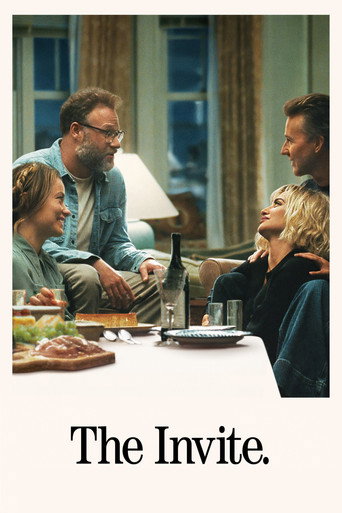
Joe and Angela's dinner with their upstairs neighbors exposes the growing strains in their marriage.
Overview, poster, and credits from TMDB.
Read and watch our full recap ↓FROM THE RECAPRUSH LIBRARY · FULL RECAP
The Invite (2026) Recap & Ending Explained: What Joe and Angela's Piano Duet Really Leaves Open
17 min read · Estimated reading time— views
Intro + RecapRush Viewpoint
The dinner party in The Invite begins with a question nobody can answer comfortably: how do you welcome strangers into a home when you can barely speak kindly to the person who lives there? Angela has arranged the evening to make a connection. Joe would rather complain about the neighbors upstairs. Their guests arrive just in time to hear the couple's resentment spill through the apartment.
Olivia Wilde's 2026 comedy turns a crowded room into a pressure cooker. The neighbors, Piña and Hawk, seem unusually open about sex, desire, and the lives they want. Joe and Angela, meanwhile, have become experts at using jokes and minor grievances to avoid the more frightening question of whether their marriage still works.
The RecapRush viewpoint: the final piano duet is moving precisely because it cannot settle that question. The couple recover a way to listen to each other for a few minutes. Whether that becomes a renewed marriage, a friendship, or a gentler separation remains their choice. The film offers a small act of attention, not a signed contract for the future.
Full spoilers ahead. This guide covers the entire released film, including the neighbors' invitation, the failed partner swap, Piña's assessment of the marriage and the ambiguous final scene. Plot facts are based on A24, Sundance, TMDB and post-release reporting checked on October 29, 2026. Interpretations are identified as such.
Featured Image
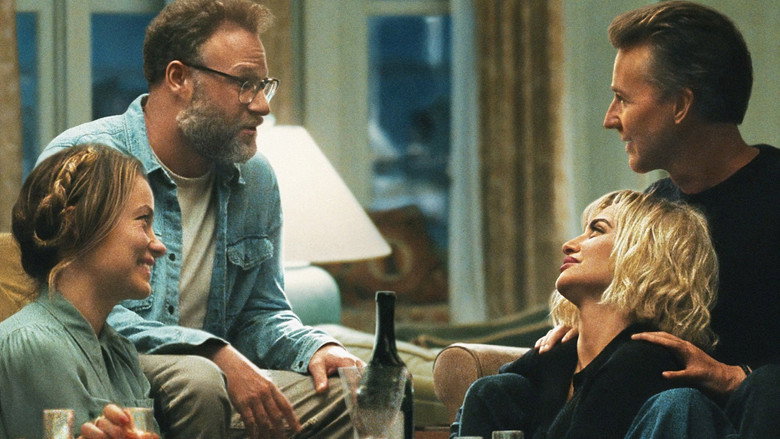
Table of Contents
Quick Facts
- Title: The Invite
- Year: 2026
- Director: Olivia Wilde
- Screenplay: Rashida Jones and Will McCormack
- Based on: Cesc Gay's 2020 Spanish film Sentimental, released in English as The People Upstairs
- Cast: Olivia Wilde, Seth Rogen, Penélope Cruz and Edward Norton
- World premiere: January 24, 2026, Sundance Film Festival
- U.S. theatrical opening: June 26, 2026, limited; July 10, wide
- U.S. HBO Max streaming: October 23, 2026
- Runtime: 107 minutes
- TMDB: Movie 950028
- TMDB genres: Comedy, Drama, Romance
- Coverage: complete released feature and its deliberately unresolved ending
Full Spoiler Recap
1. A happy memory gives way to a difficult homecoming
The film opens with the sound of a couple laughing while sharing a piano duet. It is a memory of Joe and Angela before their present frustrations hardened into a routine. The music is intimate and collaborative: each person has to make room for the other to be heard.
In the present, Joe returns to the San Francisco apartment he shares with Angela and their daughter Maggie. A musician who now teaches at a conservatory, he comes home tired and in pain. Angela is preparing dinner for their upstairs neighbors. Joe says he did not know about the invitation; Angela insists she told him.
That disagreement is small enough to sound funny, but it carries years of accumulated suspicion. Each believes the other is failing to listen. Angela wants a successful evening and some recognition for making the apartment welcoming. Joe notices another obligation in a home where he already feels uncomfortable.
2. A noise complaint becomes a proxy for the marriage
Joe and Angela can hear their neighbors having loud sex. Joe wants to confront them about it. Angela wants him to be polite and fears he will ruin the evening before it starts.
They argue over the apartment, money and the way each speaks to the other. Joe dismisses Angela's decorating work; she resents the contempt beneath his jokes. As their disagreement grows louder, the doorbell rings. They must suddenly perform hospitality in front of the very people whose private life has become a source of resentment.
The comedy comes from that abrupt change of audience. The couple's fight does not disappear because guests are present. It simply becomes another thing everyone must pretend not to notice.

3. Piña and Hawk make the awkwardness harder to hide
Piña and Hawk arrive. Piña is a sex therapist who recently divorced; Hawk is a widower. They have been together a relatively short time and speak with an ease their hosts seem to have lost. Hawk remarks that they could hear Joe and Angela fighting, immediately puncturing the idea that the apartment keeps private things private.
Angela's preparations also go wrong. She has not planned around Piña's dietary restrictions, and the dinner party is less polished than she wanted. Yet Hawk's appreciation of the apartment touches Angela. He notices the work Joe has treated as trivial, and the compliment exposes how badly she wants to be seen.
Joe eventually raises the noise upstairs. Instead of reacting with the offense Angela expects, the guests welcome his directness. A complaint meant to establish a boundary opens the conversation further.
4. The guests reveal an invitation of their own
As the couples drink and talk, Piña and Hawk explain that their active sex life includes parties with other people. Their frankness unsettles the hosts and also fascinates them. The neighbors have come with an invitation: they are interested in including Joe and Angela in their sexual world.
For a moment, the possibility gives Joe and Angela something they have not had all evening: a shared direction. Each is excited by the prospect, though neither is free of insecurity. Hawk reveals that Angela has deliberately allowed herself to be seen through a window, and Joe reacts to that information before finding reassurance in the guests' interest in him too.
Piña remains cautious about the couple's hostile dynamic. Instead of a group encounter, the four decide to split into pairs: Angela with Hawk, Joe with Piña. The arrangement sends them into different rooms, but the apartment remains small enough that their choices still affect one another.
5. Two private encounters reveal different kinds of fear
Angela goes with Hawk. Away from Joe, she faces a question she has not been able to answer easily: what does she actually want? Her nervousness interrupts the fantasy of a confident escape from the life she dislikes.
Joe and Piña share a lighter conversation and get high together. Joe's defenses briefly loosen. Then, while dancing, he falls and hurts his back. His cries interrupt the evening before either proposed sexual encounter becomes the uncomplicated adventure the hosts imagined.
The fall is physical comedy with an emotional consequence. Joe's chronic pain is real, and Angela's frustration with its effect on their lives is real too. Their inability to discuss both truths without turning them into accusations pushes the gathering toward its next argument.

6. Hawk and Piña's own tensions surface
The failed encounter brings everyone back into conflict. Angela lashes out about the way Joe's back pain affects their lives. Joe hears his pain treated as an inconvenience rather than suffering. He also mocks Hawk's chosen name.
Hawk explains the grief behind that name after the death of his wife. His account gives the name a personal weight Joe's joke ignored. Joe's insensitive response further alienates the room.
The guests are not a flawless model couple, however. When Hawk corrects Piña's English, she reacts angrily to his condescension. Their disagreement matters because it prevents the film from dividing the room into a perfect relationship and a broken one. Openness does not eliminate the possibility of hurting a partner.
7. Piña asks the question the hosts have avoided
Piña learns that Joe and Angela have not had sex for a year. Drawing on her professional experience, she asks them to talk about the relationship beneath the evening's competing grievances.
Angela describes giving up her artistic ambitions to stay home with Maggie. She believes Joe has allowed his unhappiness to shape the household. Joe, once an aspiring performer, is wounded by what he sees as failure and complains that Angela controls their shared life. The piano he refuses to play becomes a quiet measure of the ambition and pleasure both have learned to avoid discussing.
Neither account cancels the other. Angela's sacrifices do not make Joe's disappointment imaginary, and Joe's pain does not make Angela's loneliness insignificant. Their problem is partly that each has been presenting a history of hurt as a verdict on the other person.
When Piña asks why they remain together, both name Maggie. Piña challenges the assumption that staying under one roof is automatically the best gift to their daughter if the household is filled with hostility.
8. An ending becomes a possible beginning
Piña tells Joe and Angela that their relationship as it currently exists is over. If they choose, they may build a different relationship with each other. The distinction is more precise than a simple command to divorce: the pattern of contempt and avoidance cannot continue unchanged.
The hosts appear to accept the point and begin discussing practical matters, including where Joe will sleep and what to do about a planned trip. When they return from the kitchen, Piña and Hawk have left. Their sudden departure leaves Joe and Angela alone with a decision that cannot be outsourced to a guest, even a perceptive one.
9. Joe and Angela play together again
Joe goes into his office, where he plans to sleep, and sits at the piano. He begins to play for the first time in years. Angela joins him in the duet heard at the beginning. When they finish, she rests her head on his shoulder and he leans toward her.
The film ends there. It does not show a divorce, a permanent separation, or an explicit promise to remain married. The physical tenderness is real within the scene; the future it might lead to is not resolved onscreen.

Cast + TMDB
Cast and Characters




The gallery uses the film's verified TMDB cast credits and links the performers to their RecapRush profiles. Wilde gives Angela's social energy a strain that becomes visible whenever a compliment reaches her. Rogen lets Joe's sarcasm do double duty as a source of laughs and a defense against disappointment. Cruz makes Piña's frankness both inviting and disruptive, while Norton gives Hawk's confidence room for grief and awkwardness.
The four performances work through reactions as much as speeches. A joke lands differently depending on who laughs, who waits for permission, and who looks away. Those tiny shifts keep a largely indoor story in motion.
More from RecapRush
 Inception (2010) — Full Spoiler Recap & Ending Explained
 The Last Sunrise (2026) Recap & Ending Explained: Why Ry’s Smile Leaves Love Unfinished
 Senna (2010) Recap & Ending Explained: Why the Funeral Changes the Rivalry with Prost
Ending Explained
Do Joe and Angela stay together?
The film does not say. After discussing a possible separation, they reconnect at the piano, but the last shot does not establish whether they resume their marriage, separate while remaining close, or choose another arrangement.
The writers have described the ambiguity as deliberate. The duet can suggest hope without proving that a single evening has resolved years of resentment. Director Olivia Wilde has likewise said that she is unsure what happens next.
What does Piña mean when she says the relationship is over?
She is describing the marriage in its present form: a relationship structured around bitterness, diminished intimacy and arguments that substitute blame for communication. She also says that the two could start a different relationship with each other.
That distinction leaves Joe and Angela agency. Piña can name a pattern she sees; she cannot decide the couple's future for them.
Why does Joe play the piano again?
Joe has avoided an instrument associated with his former musical ambitions. Playing is a visible break in his routine. When Angela joins him, they perform an old duet from a happier time, but the film does not say that their former life can simply be recovered.
RecapRush reads the scene as a moment of cooperation in the present. They listen and respond rather than competing to deliver the last accusation. Music lets them practice a conversation before either has found a reliable verbal answer.
Are Piña and Hawk imagined?
The film does not settle that reading as a literal plot revelation. In an interview, Wilde said she was receptive to the interpretation that the neighbors function as a projection, while acknowledging that the film also works if they are real. She noted a moment in which Hawk is alone at the medicine cabinet as a complication to the projection reading.
Viewers can read the visitors as actual neighbors whose openness provokes change, or as figures that reflect possibilities Joe and Angela cannot yet express. The film leaves room for both readings; it does not prove that the dinner never happened.
Does the partner swap happen?
The couples separate into pairs, but the proposed sexual encounters do not take place. Angela is nervous with Hawk, and Joe hurts his back while with Piña. Their interrupted plan becomes the occasion for more arguments and, eventually, a more honest discussion.
RecapRush Interpretation
This is RecapRush's interpretation. The title works in two directions. Angela invites the neighbors to dinner, hoping that an evening of hospitality might restore some pleasure to her life. Piña and Hawk arrive with an invitation to a different kind of intimacy. By the end, neither invitation is the one that matters most.
The final invitation is much quieter: Joe leaves space beside him at the piano, and Angela joins. They do not have to declare what the gesture means before making it. For a couple that has spent the night turning each admission into a weapon, a shared activity without an argument is meaningful even if it remains fragile.
That reading does not require the marriage to be saved. A humane ending can be the start of romantic repair, or it can be the start of treating one another kindly while separating. The duet gives them a possibility; the movie refuses to choose for them.
Deep Analysis & Key Themes
The joke reveals the wound
Joe's comments frequently sound like throwaway irritations until someone responds to them seriously. His complaint about noise brings the guests' sexual confidence into the open. His mockery of Hawk's name invites a story about loss. In each case, the comic rhythm depends on a familiar social mistake: someone uses a joke to avoid vulnerability, then discovers that another person has heard the vulnerable subject anyway.
The laughter does not make Joe harmless. It makes his defenses recognizable. The same wit that can connect people can also deliver contempt while giving its speaker the option to claim it was only a joke.
Angela's hospitality is a request to be seen
Angela's carefully arranged apartment is not merely a shallow preoccupation. It is work through which she tries to create a life that feels considered. When Hawk admires it, her reaction suggests how rarely that labor receives attention from Joe.
That does not make every decision she makes wise. Her desire to impress the guests contributes to the evening's pressure. But the film gives that desire a human cause: she wants evidence that her choices and effort still register with another person.
Desire is not the same as knowledge of oneself
The invitation excites Angela and Joe because it promises an immediate answer to their dissatisfaction. Yet the separate encounters reveal how much uncertainty remains beneath the fantasy. Angela struggles to identify her own preferences, while Joe's nervousness and pain interrupt his imagined escape.
The comedy resists the idea that a new sexual arrangement automatically repairs an old emotional pattern. The proposed encounter does not fail because desire is wrong; it exposes questions the couple has not learned to ask each other.
A home can be both shelter and stage
The apartment holds the pair's history, their daughter's routines, Angela's renovations and Joe's neglected piano. It also has walls and windows that allow private sounds and images to cross boundaries. The neighbors can hear the hosts argue; Hawk has seen Angela through a window.
The space makes privacy complicated. It protects the characters from the outside world while making it difficult to escape the roles they have rehearsed inside it. Moving into different rooms creates opportunities for new conversations, but none of those rooms is far from the marriage at the center.
Parenting does not automatically settle the decision
Joe and Angela both identify Maggie as the reason they remain together. The answer shows genuine concern for their daughter, but it also gives them a way to postpone an assessment of what their daily conflict teaches her.
Piña's challenge is not that parents should separate whenever life becomes difficult. It is that a child can experience the emotional climate of a household. The ending does not decide which family arrangement is best; it asks the adults to consider more than the appearance of staying together.
The duet makes attention audible
At the beginning, music comes from the past. In the final scene, Joe plays in the present and Angela joins him. A duet is not a debate with a winner. It requires timing, listening and adjustment.
This metaphor is a RecapRush reading, not proof that the characters have solved their problems. Its power lies in its modesty: the film shows a different interaction before it offers any guarantee that the difference will last.
What Most Viewers Missed
The guests' apparent ease is not perfection
Piña's reaction when Hawk corrects her English complicates the comparison between the couples. Even the pair who communicate openly can slip into condescension. Their usefulness to Joe and Angela lies in provoking questions, not offering a flawless template.
The first invitation fails as a performance but succeeds as a conversation
Angela's food and hosting plans do not unfold as intended. The evening becomes productive only when the guests stop pretending that everything is comfortable. The dinner's social failure creates the conditions for emotional honesty.
Joe's piano is more than an abandoned career
The instrument represents a part of himself he has protected by leaving untouched. Playing it risks encountering disappointment, but not playing it has also made that disappointment permanent. Angela joining him changes the piano from a private monument into a shared space.
Hawk's name shifts a punchline into a grief story
Joe treats the name as an easy target. Hawk explains that it is tied to his life after his wife's death. The reversal asks viewers to reconsider how quickly someone else's self-invention can be dismissed when its history is unknown.
The film's final answer is smaller than the crisis
After hours of dramatic revelations, the ending offers a few minutes at a keyboard. That restraint keeps the characters' future open. A gesture can matter without bearing the impossible burden of proving a lifelong reconciliation.
Mid/Post-Credits
Checked credit guides report no additional scene during or after the credits. The film includes a dedication, “For Diane,” in the credits. The piano duet is the final narrative scene.
Final Thoughts
The Invite finds its comedy in the distance between what people want to appear to be and what they reveal when a pleasant evening becomes impossible to manage. Its guests are catalysts, not magical solutions. Piña's clarity and Hawk's openness expose Joe and Angela's habits, but the hosts still have to decide what to do with that knowledge.
The final duet earns its tenderness by refusing certainty. Joe and Angela can remember the people they were without pretending that memory alone repairs the people they have become. For one scene, they make something together instead of making a case against each other. What follows is left where it belongs: beyond the screen and beyond any stranger's confident diagnosis.
FAQ
When did The Invite premiere?
Its world premiere was at Sundance on January 24, 2026. A24 opened it in U.S. theaters on June 26, followed by a wider release on July 10.
Who directed The Invite?
Olivia Wilde directed the film and plays Angela. Rashida Jones and Will McCormack wrote the screenplay.
Is The Invite based on another movie?
Yes. It is an English-language remake of Cesc Gay's 2020 Spanish film Sentimental, also known as The People Upstairs.
Do Joe and Angela divorce?
The film does not show or confirm a divorce. They discuss separating and then share a piano duet; their eventual decision remains open.
Did the two couples have sex?
No sexual encounter occurs during the proposed partner swap. Angela is nervous, and Joe injures his back.
Are Piña and Hawk real?
The film does not provide a definitive answer to the projection interpretation. Wilde has discussed that reading while allowing that the story also works with the guests understood as real.
Is there a post-credits scene?
No. Checked credit guides report no additional scene during or after the credits.
Join the conversation
What did you think of the ending? Share your interpretation. Spoilers may appear below.
This product uses the TMDB API but is not endorsed or certified by TMDB.
No comments yet. Start the conversation.