

RECAPRUSH MOVIE GUIDE
Clayface (2026)
Directed by James Watkins
An actor whose face is disfigured seeks experimental regenerative treatment. His restored appearance gives way to unstable shapeshifting powers and a destructive campaign of revenge.
Overview, poster, and credits from TMDB.
Read and watch our full recap ↓FROM THE RECAPRUSH LIBRARY · FULL RECAP
Clayface (2026) Recap & Ending Explained: Why Matt’s Last Love Scene Is His Cruelest Performance
18 min read · Estimated reading time— views
Intro + RecapRush Viewpoint
Matt Hagen wants his face back because he believes the rest of his life will follow. His work, his friends, the chance to be desired: all of it seems to have vanished with the appearance that made him a star. Clayface grants that wish, then asks what happens when an actor can change every face in a room except the one person’s answer he cannot accept.
James Watkins’ film begins with a recognizable Hollywood nightmare and ends with a performance that has no independent scene partner. Between those points, Matt’s pursuit of repair becomes a campaign of revenge. His injuries explain his desperation. They do not excuse the choices that turn other people into material for his story.
RecapRush’s viewpoint: the decisive horror is not that Matt loses a stable appearance. It is that he starts confusing the ability to impersonate someone with the right to occupy that person’s life. The last encounter with Caitlyn makes that confusion painfully literal. He can manufacture the response he wants, but he cannot make it a freely given response.
Full spoilers for Clayface (2026), including every major death, the John Borrelli reveal and the final sewer sequence. This is a source-checked recap and original analysis, not a claim of firsthand viewing. Plot events are distinguished from RecapRush interpretations; uncertain biological explanations are not presented as established facts. Release and source checks: October 25, 2026, Mongolia time.
Featured Image

Table of Contents
Quick Facts
- Title / year: Clayface (2026)
- Format / language: American feature film / English
- Director: James Watkins
- Screenplay: Mike Flanagan and Hossein Amini; story by Flanagan
- Distributor: Warner Bros. Pictures; DC Studios presentation
- Earliest verified premiere: October 13, 2026, Hollywood Legion Theater, Los Angeles. This premiere is distinct from general theatrical release.
- U.S. theatrical opening: October 23, 2026; released, not an upcoming preview
- International rollout: the distributor announced international theatrical releases beginning October 21; individual market and advance-screening dates can differ.
- Runtime: approximately 108 minutes, supported by classification records; TMDB currently rounds/listings may display 109.
- U.S. rating: R
- TMDB movie ID: 1400940
- TMDB genres: Horror, Thriller, Science Fiction
- Coverage: complete theatrical story and ending. No streaming date is asserted without an official announcement.
Full Spoiler Recap
1. A star discovers how conditional his protection was
Matt Hagen reaches a career high with an Academy Award nomination. His professional circle includes agent Hildie Love, manager Frank Fitzpatrick and childhood friend Corey Bowery, now another actor. Success appears to have carried him beyond the precarious world he came from.
During a night out in Gotham, he sleeps with Mia Torrez despite Corey’s warning that she is involved with mobster Markos Szabo. Szabo retaliates by mutilating Matt’s face. Attempts at reconstruction consume his resources without restoring the life he expected. His case against the gangster fails, damaging stories circulate, and the people who marketed his success become much less interested in standing beside him.
Matt’s return to poverty is therefore social as well as financial. The face that once opened doors now exposes how little protection those doors offered. His suffering is real; the film has not yet made his later revenge inevitable.
2. Caitlyn offers repair rather than a guaranteed comeback
Matt finds Dr. Caitlyn Corr, whose experimental nanotechnology is designed to regenerate damaged tissue. She has reasons to be cautious about using it on a human subject. He has reached the point where uncertainty seems preferable to the life he is living.
Caitlyn eventually treats him, and the early results restore his familiar appearance. Her fiancé, Gotham detective John Borrelli, remains part of her life. Matt’s gratitude and growing attraction develop inside that existing relationship, not in an empty romantic space waiting for him to fill it.
The treatment gives Matt an opening, but he quickly treats an opening as a completed recovery. He returns to a public premiere before the process is ready. As his emotions rise, his face begins to sag. The comeback turns into another scene of exposure.
3. Matt tries to overpower the treatment’s limits
Back with Caitlyn, Matt wants the failure reversed immediately. He injects an excessive quantity of the nanite serum instead of accepting the measured course of treatment. What follows is not simply a more durable version of his old face: his body acquires extraordinary regenerative and shape-changing properties.
Those properties respond to emotion. Anger and desire produce transformations before he has learned to direct them. The flight sequence, in which tissue closes over his eyes and he struggles with scissors, turns that lack of control into immediate bodily panic.
Caitlyn’s observations connect the changing body to what Matt is feeling. He can take on other people’s appearances, but he cannot yet treat appearance as a neutral costume. The people occupying his thoughts emerge on his skin. The actor’s work and his most private impulses have become frighteningly difficult to separate.

4. A confrontation becomes a method of escaping accountability
Matt discovers that Frank has aligned himself with Szabo. During their confrontation, the manager also exposes Corey’s part in the campaign that helped the gangster. Matt tries to silence Frank, and his unstable body turns the encounter into a fatal attack.
The aftermath introduces a dangerous lesson: Matt can assume the dead man’s appearance and leave. His power does not merely let him strike someone stronger. It can remove the ordinary connection between a person’s face, the witnesses who see that face and the act being investigated.
He then confronts Corey on a production set. Corey admits betraying him. An apparent embrace becomes a deliberate suffocation, and Matt takes his friend’s identity into a filmed scene. The progression matters. The first killing can be described as a confrontation spiraling beyond control; the next involves a choice to continue after the betrayal is understood.
5. Protecting Caitlyn and claiming Caitlyn begin to merge
As John investigates the killings, Caitlyn becomes increasingly troubled by Matt’s behavior. Matt’s feelings for her do not change the fact that she remains committed to John. He nevertheless starts imagining a relationship whose terms she has not agreed to.
When one of Szabo’s men follows Caitlyn, Matt uses her appearance to draw the threat toward himself and kills the man. He then borrows another identity to reach the mobster’s territory. What begins with an act that can be understood as protection becomes part of the machinery of his larger revenge.
The film has now placed two desires beside one another: he wants to keep Caitlyn safe, and he wants to be the person she chooses. His later actions will show how violently he can confuse the two.
6. Vesuvius turns impersonation into a public weapon
Matt returns to the nightclub where his collapse began. On the dance floor and among Szabo’s men, he changes faces to confuse the people trying to stop him. Fighting someone becomes difficult when a familiar face may conceal an attacker and gunfire does not reliably stop the body beneath it.
He reaches Szabo’s private room by copying Patches, creating a situation in which the gangster sees two versions of the same man. Mia dies after part of Matt’s flesh blocks her throat. Matt then uses his regenerative blood against Szabo, returning the original violence to its author in a grotesquely altered form.
The revenge has reached its original target. It does not restore Matt’s career, erase his own murders or resolve his attachment to Caitlyn. The film still has its most consequential impersonation ahead.
7. John’s face cannot make Matt John
John’s investigation closes in, and Caitlyn recognizes the connection between Matt and the murders. When she returns home, she appears to be speaking with her fiancé. The discovery of John’s body reveals the truth: Matt has killed him and is using his appearance.
This is the point where the revenge rationale fails completely. John is not the man who destroyed Matt’s face. He is the person standing between Matt and the romantic outcome Matt wants. Borrowing his features becomes an attempt to bypass Caitlyn’s choice.
She resists. A taser destabilizes Matt’s already volatile body, and she activates the nanite termination system. In the confrontation’s final moments, Matt himself urges her to end it. His body breaks apart and washes into the drainage system. For the moment, it looks as though the experiment and the man are gone.
8. Survival produces one final scene partner
Investigators do not recover a body. Later, Caitlyn gives money to an unhoused man who performs a familiar gesture. The disguise belongs to Matt: he has survived and is living beneath the city.
The final sequence appears to supply what the rest of the film denied him. Caitlyn seems to arrive, accept him and offer a reconciliation. Then the image exposes its construction. The Caitlyn beside him is formed from his own mutable body. There is no freely choosing partner completing this love scene.
Matt remains alive, but the reunion is false. His final monstrous appearance and scream leave him with a power that can manufacture company without repairing his isolation. He has become Clayface, and his last performance cannot persuade anyone except himself.
Cast + TMDB
Cast and Characters




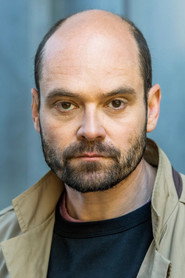

The gallery uses verified TMDB cast records, portraits and RecapRush actor-profile links. It includes Tom Rhys Harries as Matt Hagen / Clayface, Naomi Ackie as Caitlyn Corr, Eddie Marsan as Frank Fitzpatrick, Max Minghella as John Borrelli, David Dencik as Markos Szabo and Joshua James as Corey Bowery.
Harries’ role depends on the distance between a man who expects to be watched and one who cannot bear being seen. Matt’s restored confidence makes the interruptions of his body more revealing: a familiar smile cannot keep the anger beneath it from becoming visible.
Ackie’s Caitlyn is the essential counterweight because her attention has several meanings that Matt wants to simplify into one. Curiosity, care, responsibility and attraction are not interchangeable promises. Minghella’s John makes that distinction consequential. Matt can borrow the detective’s exterior, but the life attached to it includes a relationship he cannot legitimately inherit.
More from RecapRush
 Coyote vs. Acme (2026) Recap & Ending Explained: Why Wile E. Has to Lose
 Call My Agent! The Movie (2026) Recap & Ending Explained – Andréa, Noémie, and the Former ASK Team
 Wake Up Dead Man: A Knives Out Mystery (2025) Recap & Ending Explained: Why Blanc Refuses His Victory
Marsan and James occupy different positions in Matt’s sense of betrayal: professional trust and shared history. Dencik’s Szabo supplies the original brutality. The story becomes darker when Matt moves beyond returning that brutality and begins deciding who may exist around the woman he wants.
Ending Explained
Is Matt really alive after the nanites are terminated?
Yes. The later disguise and the final reveal establish his survival. Caitlyn’s activation of the termination system causes an apparent physical collapse, but it does not permanently destroy him.
The exact mechanism is not fully explained. A theory that the altered cells have become autonomous can make sense of what happens, but it remains an inference. The film’s outcome is firmer than its scientific explanation: Matt exists after the apparent dissolution. We should not convert that into an invented rule that he is immortal or that no future method could stop him.
Does Caitlyn forgive him and join him underground?
No. The final Caitlyn is a bodily fabrication created by Matt. The apparent reconciliation is part of the reveal, not evidence that the real woman has accepted John’s murder or chosen a life with his killer.
This distinction changes the scene’s emotional meaning. What first resembles an impossible romantic reprieve becomes evidence of Matt’s refusal to live with another person’s answer. RecapRush reads it as a performance of forgiveness in which he controls both roles. It can look like intimacy only while we mistake the copy for an independent person.
Why kill John when Szabo is already dead?
John’s death exposes the difference between revenge and possession. Matt cannot explain it as punishment for the original attack. The detective is also Caitlyn’s fiancé, and replacing him offers Matt the fantasy that he can enter the relationship without earning or receiving her consent.
Matt’s ability has outgrown the role he originally assigned it. A face first restored so that he could reclaim his own life is now used to take another life’s place. That is the self-contained tragedy of this film: an actor who wanted his identity returned ends by treating identities as things he can seize.
Is Matt’s final request to end the experiment a redemption?
It is a moment of recognition, not a reversal of what he has done. Matt briefly understands that the situation must stop. That recognition deserves weight, but the ending does not restore John or undo the other killings.
The manufactured reunion also complicates any claim of completed moral change. Matt still creates the answer he desires. RecapRush’s reading is that he can recognize horror in one moment and remain trapped by entitlement in the next. The film does not give him a clean absolution.
RecapRush Interpretation
Matt’s deepest wish is not simply to look attractive. It is to recover the certainty that his appearance will produce a particular response. The original attack takes away his power to manage how other people see him. The experiment eventually gives him far more control over appearances than he ever possessed as a star, but it cannot guarantee recognition, loyalty or love.
That failure is why the last image is so exact. He no longer has to wait for another actor to arrive, learn the lines or disagree with the scene. He can make the partner himself. The apparent solution destroys the thing that makes the relationship worth wanting: the presence of someone whose desires are not his own.
The film also makes it possible to hold two judgments together. Matt is subjected to horrific violence and opportunistic abandonment. Later, he commits acts for which those experiences are not a defense. Treating him only as an innocent victim would erase the choices that complete his transformation. Treating his earlier pain as irrelevant would make the descent emotionally meaningless.

Deep Analysis & Key Themes
A public comeback is not the same as recovery
The premature return to a premiere is a revealing choice. Matt wants a public demonstration that he is himself again, while Caitlyn’s process still requires uncertainty and limits. He measures the success of treatment through an audience’s reaction before he understands what his body is doing.
The red carpet repeats the conditions that made him vulnerable: visibility, judgment and the need to appear effortless. When the face fails, the humiliation is not merely cosmetic. His attempt to announce control exposes its absence. The later overdose follows that impatience with limits rather than arriving as an unrelated accident.
The body makes concealed feelings visible
Matt’s transformations initially respond to anger and desire. An actor ordinarily distinguishes the person he is playing from the feelings he keeps private. Here that separation breaks down. A thought can become a face before he has decided to show it.
The resulting irony is that a power associated with perfect disguise begins by betraying him. It does not first provide freedom from his inner life. It gives that inner life an exterior he cannot reliably manage. As he learns control, the question shifts from whether his body will expose him to how he will exploit its ability to conceal him.
Betrayal makes revenge tempting, not sufficient
Frank and Corey matter because each relationship contains a promise beyond money. A manager is entrusted with practical survival; an old friend is entrusted with the memory of who you were before success. Discovering their betrayal makes Matt’s anger comprehensible.
But the film’s progression from the first fatal confrontation to the purposeful killing of Corey asks the viewer to track decisions, not just grievances. His new capacity to escape recognition removes a restraint. What he chooses after discovering that freedom tells us more than the fact that he has been hurt.
Impersonation exposes the limit of performance
The nightclub sequence turns disguise into tactical advantage. The John reveal turns the same technique into an ethical violation with no possible romantic defense. The copied face can get Matt into a conversation, but it cannot make the relationship underneath that conversation belong to him.
The last fabricated Caitlyn carries the idea one step further. Earlier he replaced someone else. Now he dispenses with an independent person altogether. RecapRush reads that movement as the final contraction of his world: unlimited outward forms, fewer genuine relationships, and eventually a scene that never leaves his own body.
What Most Viewers Missed
The failed premiere sets up the ending’s false performance. In both, Matt wants an audience response to certify that he has become the person he needs to be. At the end, he controls the response as well as the appearance.
Frank’s death and Corey’s death are not morally identical events. The distinction between a confrontation escalating and a deliberate act matters to the character arc. Describing every killing as an uncontrollable side effect obscures the agency Matt acquires.
John is the limit of the revenge explanation. His murder forces the story out of a comfortable account of an injured man punishing his tormentors. The victim’s place in Caitlyn’s life becomes part of Matt’s motive.
The sewer encounter contains a factual reveal and an interpretive meaning. Matt’s survival is established. The apparent forgiveness is exposed as fabricated. What that says about his need for approval is analysis, not a medical explanation of his abilities.
The ending does not need Batman to complete its argument. Matt’s last choice resolves the central question about what he does with other people’s identities. A future confrontation with a superhero is not required to understand this film’s tragedy.

Mid/Post-Credits
GamesRadar+’s postrelease ending guide explicitly reports no post-credits scene. The final revelation about Matt and the fabricated Caitlyn belongs to the film’s ending; it should not be mislabeled as an after-credits sequel teaser. This article does not invent an additional cameo or a separate mid-credits event.
Final Thoughts
Clayface’s most useful question is not whether a handsome actor can remain himself after losing his looks. It is whether being able to look like anyone makes him more willing to acknowledge that other people are separate from him.
The answer grows darker as the story proceeds. Matt learns how to enter rooms, evade witnesses and borrow intimacy. He never learns how to accept that care does not confer ownership. His last scene gives him the response he wants at the cost of the person who would have to give it. That is a crueler ending than a simple monster victory: he can reproduce the shape of love while remaining alone.
FAQ
When was Clayface released in the United States?
Warner Bros. opened it theatrically on October 23, 2026. Its verified Los Angeles premiere was October 13. The earlier September date found in old previews is not the final U.S. opening date.
Is this a full recap or an upcoming preview?
It is a complete spoiler recap of the released 2026 feature, including the nightclub revenge, John’s death, the apparent termination and the final survival reveal.
What is the correct TMDB ID?
The movie ID is 1400940. The article concerns James Watkins’ film starring Tom Rhys Harries, not an animated episode or another Clayface incarnation.
Does Matt die?
No. He survives the apparent dissolution. The film establishes survival without providing a fully worked-out explanation for why the termination system fails to destroy him permanently.
Is the last Caitlyn real?
No. Matt creates her likeness from his own body. The apparent reunion does not mean the real Caitlyn has forgiven him or chosen him.
Does Batman appear?
No. Postrelease coverage confirms that Batman does not appear in this film. No future meeting is treated here as an announced movie scene.
Who wrote and directed Clayface?
James Watkins directed. Mike Flanagan and Hossein Amini wrote the screenplay, with story credit to Flanagan.
Can I stream it now?
At this verification point it is a new theatrical release. The checked material does not establish an officially announced home-streaming date. Estimates based on other Warner Bros. movies are not release announcements.
Join the conversation
What did you think of the ending? Share your interpretation. Spoilers may appear below.
This product uses the TMDB API but is not endorsed or certified by TMDB.
No comments yet. Start the conversation.