
RECAPRUSH TV GUIDE
Adolescence (2025)
When a 13-year-old is accused of the murder of a classmate, his family, the psychological expert and the detective in charge are all left asking: what really happened?
Overview, poster, and credits from TMDB.
Read and watch our full recap ↓FROM THE RECAPRUSH LIBRARY · FULL RECAP
Adolescence (2025) Recap & Ending Explained: Why Jamie’s Guilty Plea Cannot Give His Father Closure
10 min read · Estimated reading time— views
Intro + RecapRush Viewpoint
A father can hold his frightened son and still have no idea who he is holding. That is the terrible space Adolescence asks us to inhabit. Its central question moves beyond whether a child committed murder to something harder: how do the people who love him live with the answer?
RecapRush’s reading is that the series concerns the distance between protection and understanding. Eddie Miller knows how to provide for his family. He does not know everything taking shape inside Jamie’s emotional life. The drama turns that gap into a tragedy without offering the comfort of a single villain who explains it all.
Spoiler warning: This article discusses all four episodes, Katie’s murder, Jamie’s decision and the final scene. Interpretive sections present RecapRush’s analysis, not a clinical diagnosis or a claim about every teenager.
Featured Image
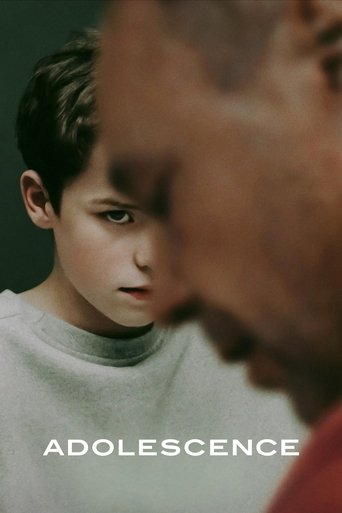
!Official Adolescence key art for the four-part Netflix crime drama
Image source: TMDB’s Adolescence record. Promotional key art; rights remain with the respective rights holders.
Table of Contents
Quick Facts
- Title: Adolescence
- Year: 2025
- Format: Four-part live-action limited series
- Release: March 13, 2025, on Netflix
- TMDB TV ID: 249042
- TMDB genres: Drama; Crime
- Creators and writers: Stephen Graham and Jack Thorne
- Director: Philip Barantini
- Language: English
- Story scope: All four episodes of the released limited series
Netflix confirms that each episode was filmed as one continuous shot. The uninterrupted form is central to the viewing experience: the camera stays with discomfort instead of releasing it through a conventional cut.
Full Spoiler Recap
1. The arrest destroys the family’s familiar world
Police enter the Miller home and arrest thirteen-year-old Jamie for the murder of his schoolmate Katie Leonard. Eddie accompanies his son through questioning as his appropriate adult. Jamie denies responsibility. CCTV evidence then shows him attacking Katie, destroying Eddie’s belief that the police have made a mistake.
The opening does not preserve innocence as a mystery prize. It strips away that possibility so that the remaining episodes can examine consequences. RecapRush reads Eddie’s position here as a collision between two duties: recognizing evidence and remaining a parent. Loving Jamie does not make the recording disappear, but seeing the recording does not switch off love.
2. The school reveals a language adults cannot read
Detectives Luke Bascombe and Misha Frank visit the school. Luke’s son Adam explains the insulting meanings carried by Katie’s emoji replies to Jamie online. Ryan’s connection to the knife also emerges. The investigation exposes a peer world of humiliation, secrecy and misogynistic ideas.
The important dramatic movement is from visible evidence to invisible meaning. A message can be available on a screen while remaining incomprehensible to an adult looking at it. Luke’s authority as a detective cannot automatically supply fluency in his son’s social world.
RecapRush’s interpretation is that the school sequence questions the assumption that proximity equals knowledge. Adults and children occupy the same buildings but interpret events using different emotional vocabularies. That gap helps explain why warning signs can exist in public without being understood.
3. Briony’s interview replaces a simple explanation with contradictions
Months later, clinical psychologist Briony Ariston assesses Jamie at a secure training center. Their conversation explores his attitudes toward women, attraction and himself. He alternates between apparent openness and anger. The professional meeting becomes especially volatile when his need for personal approval presses against Briony’s boundaries.
Jamie recounts asking Katie out after an intimate photograph of her had been circulated without her consent. He believed her vulnerability might improve his chances; she rejected him. His account makes the relationship between wounded pride and entitlement disturbing rather than sympathetic.
Briony tells him this is their last meeting. He demands to know whether she likes him, becomes agitated and is removed. She is left visibly shaken. The episode ends without giving Jamie the reassurance he tried to extract.
RecapRush reads that demand as the episode’s crucial psychological pressure point. Jamie wants an evaluation to become a verdict on whether he is lovable. Briony cannot honestly answer an institutional question by surrendering her personal boundaries. The painful distinction is that understanding someone is different from granting every reassurance they request.
4. Eddie’s birthday becomes another encounter with the crime
The finale returns to the Millers roughly thirteen months after the arrest. Eddie’s fiftieth birthday cannot remain an ordinary family occasion. His van has been vandalized; an uncomfortable encounter during a shopping trip adds pressure. Even attempts at normality keep pulling the family back toward Jamie.
Jamie calls and tells Eddie that he intends to plead guilty. The parents confront what they missed, and the family considers how to continue living together. Eddie eventually enters Jamie’s bedroom, breaks down, tucks in a teddy bear and apologizes.
The series ends with a domestic gesture rather than a courtroom resolution. The teddy bear preserves an image of childhood that Eddie can still touch. The son who occupied that childhood is elsewhere, and Katie can never return to hers.
Cast + TMDB
The series is matched to TMDB TV 249042. Principal performances include Owen Cooper as Jamie Miller, Stephen Graham as Eddie Miller, Ashley Walters as Detective Inspector Luke Bascombe and Erin Doherty as Briony Ariston. The portrait gallery uses credited TMDB records and links to RecapRush actor profiles; it does not repeat the cast in an actor-versus-character table.
Ending Explained
Does the ending reveal that Jamie was innocent?
No. The surveillance footage establishes his responsibility early. The finale changes his response to that reality: he announces a guilty plea. It is an acknowledgment, not a reversal of the evidence.
Why does Eddie apologize to the teddy bear?
The bear becomes a substitute for the child he cannot hold. In RecapRush’s reading, Eddie is grieving both the person Jamie harmed and the version of his son he thought he understood. An apology can express responsibility and regret without proving that Eddie caused the murder.
More from RecapRush
 Fall 2: Deadpoint (2026) Recap & Ending Explained: Why Jax Keeps the Last Canister
 Unforgiven (1992) Recap & Ending Explained: Why Munny’s Victory Cannot Make Him Innocent
 Once Upon a Time in the West (1968) Recap & Ending Explained: Why Harmonica Leaves Jill
The show does not dramatize a completed trial or assign a sentence. It closes on the family’s emotional reckoning, leaving legal outcomes beyond the story shown.
Does the guilty plea give the family closure?
It gives them clarity about Jamie’s decision. Closure is a much larger promise, and the bedroom scene refuses it. Knowing what happened cannot reconstruct their previous life.
A useful distinction is between uncertainty and grief. The first can be reduced by evidence. The second cannot be solved by evidence alone. Eddie has reached a point where denial cannot protect him, but that is only the beginning of learning to live with the truth.
RecapRush Interpretation
The strongest reading of the final image is that parenthood survives knowledge it cannot absorb. Eddie’s affection has not vanished. Its familiar expressions now have nowhere appropriate to land, so he directs them toward a toy.
That gesture is devastating because it offers no practical solution. He cannot repair the crime by tucking in the bear. Yet the movement communicates something a speech could flatten: the habits of care outlast the world in which they once felt adequate.
This also makes the title more troubling. Adolescence usually suggests movement toward an adult identity. Here, the audience encounters a child whose actions have catastrophic consequences while his emotional need for approval remains painfully young. Neither side cancels the other.
Deep Analysis & Key Themes
Humiliation is a feeling; entitlement is a claim
Jamie’s insecurity helps us understand his vulnerability to destructive ideas. It does not justify treating a girl’s refusal as an injury that she must pay for. The distinction matters because a recap can accidentally repeat the perpetrator’s logic if it treats rejection as a cause that excuses violence.
RecapRush reads the drama as exposing the step between feeling unwanted and imagining that another person owes you affection. A feeling becomes dangerous when a worldview turns it into permission. The interview’s changing tone makes that process more revealing than a tidy explanatory monologue would be.
Briony’s boundaries carry the moral tension
Briony listens, questions and responds. She does not provide the unconditional endorsement Jamie seeks. Her position illustrates a difficult form of care: taking another person seriously while refusing the terms they impose on the relationship.
The viewer may want her to say the right thing and unlock him. That desire mirrors a familiar faith in therapeutic dialogue as an instant cure. The episode resists it. Listening is necessary, but a conversation does not erase agency, undo violence or guarantee transformation.
The continuous shot denies emotional escape
Each episode’s single-shot construction makes waiting part of the drama. We remain present as a conversation changes direction or an ordinary errand becomes unbearable. The camera’s continuity places the viewer inside a situation rather than above it.
RecapRush’s reading is that this form weakens the fantasy of perfect hindsight. You cannot simply skip the awkward seconds in which understanding fails. Time keeps passing while people improvise, hesitate and say things they cannot take back.
Katie must remain more than a motive
A story centered on the killer’s family risks shrinking the victim to a mechanism for someone else’s development. Readers should resist that narrowing. Katie is the person whose future was taken; the Millers’ suffering does not replace hers.
This is an interpretive responsibility rather than a hidden plot revelation. Compassion for Eddie and moral attention to Katie are compatible. The series becomes less useful if we turn either into a competition.
What Most Viewers Missed
The change of question arrives early. Once the evidence is shown, treating later episodes primarily as clues to innocence misses their purpose. The remaining suspense concerns understanding, acknowledgment and consequences.
Jamie seeks approval in different relationships. His dependence on Eddie’s belief and his pressure on Briony can be read together. Both involve another person being asked to stabilize his image of himself. Their relationships differ, but the repeated emotional demand is revealing.
The teddy bear does not certify innocence. Its symbolism concerns Eddie’s memory and grief. A childhood object can coexist with a devastating truth about the child who loved it.
Technical virtuosity serves discomfort. The continuous take is not merely a stunt to admire. Its value lies in the absence of an easy exit from moments that become emotionally unmanageable.
Mid/Post-Credits
No additional mid- or post-credits plot event is asserted here. The verified narrative endpoint is Eddie’s bedroom scene; the sources cited below do not establish a separate credit-sequence revelation. This article does not invent a sequel tease or a later legal outcome.
Final Thoughts
Adolescence is most powerful when it lets competing truths remain visible: Jamie is a child; Jamie is responsible; Eddie loves him; Eddie did not fully understand him. A lesser drama might resolve those tensions by choosing one and minimizing the others.
RecapRush’s final perspective is that the bedroom scene asks what love can do after it loses the power to protect. It can acknowledge, grieve and continue to exist. It cannot supply innocence, erase Katie or return the family to the morning before the police arrived.
FAQ
Is Adolescence based on one specific true crime?
Netflix describes it as a fictional story rather than a direct retelling of a single case. Real concerns about violence against girls informed its creation.
How many episodes does this recap cover?
All four episodes of the 2025 limited series.
Why is the final scene about Eddie rather than a trial?
The ending focuses on the family’s reckoning. RecapRush reads its domestic setting as a way to show consequences that a legal verdict cannot contain.
What is the correct TMDB ID?
249042, in TMDB’s TV category. It should not be stored as a movie ID.
Join the conversation
What did you think of the ending? Share your interpretation. Spoilers may appear below.
This product uses the TMDB API but is not endorsed or certified by TMDB.
No comments yet. Start the conversation.