

RECAPRUSH TV GUIDE
Attack on Titan (2013)
Directed by Tetsuro Araki
After a century of safety behind enormous walls, humanity faces extinction when the Colossal Titan breaches Shiganshina and Eren Yeager joins the fight.
Overview, poster, and credits from TMDB.
Read and watch our full season recap ↓FROM THE RECAPRUSH LIBRARY · FULL SEASON RECAP
Attack on Titan Season 1 (2013) Recap & Ending Explained: Why the Final Monster Is Hidden Inside the Wall
19 min read · Estimated reading time— views
Intro + RecapRush Viewpoint
The first horror in Attack on Titan Season 1 is a giant face above a wall. The last is a giant face inside one. Between those images, the anime steadily dismantles humanity's most comforting assumption: that the walls are a simple border between civilization and monsters.
Eren Yeager begins with a clean, furious worldview. Titans killed his mother; therefore, freedom means killing every Titan. Season 1 keeps complicating that certainty. Eren becomes the weapon he hates. Soldiers die because they trust him, and others die because he does not trust them soon enough. The enemy can wear a familiar face. By the finale, even the architecture protecting humanity has become evidence in an unsolved crime.
RecapRush's viewpoint: Season 1 is a story about the psychological cost of replacing knowledge with certainty. Eren uses rage to keep grief from paralyzing him. Mikasa uses vigilance to keep loss from repeating. Armin doubts himself even when his observations save everyone. Erwin accepts moral responsibility without pretending his choices are clean. Their survival depends not on being fearless, but on learning which fear contains useful information.
Full spoilers follow for the original 25-episode 2013 first season only. This article does not reveal events, identities, or answers from later seasons.
Featured Image

Table of Contents
Quick Facts
- Series: Attack on Titan (Shingeki no Kyojin)
- Season covered: Season 1 only
- Episodes: 25
- Original Japanese run: April 7–September 29, 2013
- Director: Tetsuro Araki
- Series composition: Yasuko Kobayashi
- Original manga: Hajime Isayama
- Animation studio: Wit Studio
- Verified TMDB genres: Animation, Sci-Fi & Fantasy, Action & Adventure
- TMDB identity: TV 1429, Season 1
- Season boundary: This recap ends with Annie's crystallization and the Titan revealed inside Wall Sina.
Full Spoiler Recap
Episodes 1–2: Shiganshina falls
Episode 1 — “To You, in 2000 Years: The Fall of Shiganshina (1).” Eren resents the safety of life inside three enormous walls and dreams of joining the Survey Corps. His mother, Carla, calls that ambition suicidal. The argument becomes irrelevant when the Colossal Titan appears above Wall Maria and kicks open Shiganshina's gate. Falling debris crushes Carla's legs. Hannes wants to fight the Titan approaching her, but terror forces him to carry Eren and Mikasa away. Eren watches the Titan eat his mother and transforms helpless grief into a vow to exterminate every Titan.
Episode 2 — “That Day: The Fall of Shiganshina (2).” The Armored Titan breaks the inner gate, making the loss of Wall Maria permanent. Refugees crowd behind Wall Rose, where food scarcity exposes how thin civilization's safety really was. A disastrous government campaign sends many refugees—including Armin's grandfather—to their deaths under the language of reclamation. Eren, Mikasa, and Armin enter military training. Eren's vow is personal, but the social order already treats expendable lives as a resource.

Episodes 3–4: The 104th Cadet Corps
Episode 3 — “A Dim Light Amid Despair: Humanity's Comeback (1).” Instructor Keith Shadis breaks recruits down to expose their weaknesses. Eren repeatedly fails the vertical maneuvering test and fears his body will betray his purpose. The real problem is defective equipment. When a working harness lets him balance, the moment establishes a recurring idea: apparent personal failure can be a systems failure, and evidence matters more than humiliation. Fellow cadets include determined Jean, reserved Annie, powerful Reiner and Bertolt, comic but resilient Sasha and Connie, and gentle Christa.
Episode 4 — “The Night of the Closing Ceremony: Humanity's Comeback (2).” Annie demonstrates that technique can redirect strength, while Eren's persistence earns him fifth place among the graduating cadets. The top ten can choose the safer Military Police, yet Eren's speech persuades several friends to consider the Survey Corps. Before anyone can settle into adulthood, the Colossal Titan reappears at Trost. Eren attacks immediately. It vanishes in steam, leaving the gate breached and the new soldiers facing the catastrophe they trained to prevent.
Episodes 5–8: Trost and the impossible Titan
Episode 5 — “First Battle: The Struggle for Trost (1).” Eren's confidence collapses against real Titans. His squad is slaughtered almost instantly. When Armin freezes before a Titan, Eren drags him out of its mouth and is swallowed in his place. The apparent death is deliberately abrupt: fury cannot protect Eren from the indifference of battle. Armin survives with the guilt of being saved.
Episode 6 — “The World the Girl Saw: The Struggle for Trost (2).” Mikasa fights with extraordinary control, and her childhood explains its emotional source. Human traffickers murdered her parents; young Eren killed two kidnappers and urged her to fight the third. He then wrapped his scarf around her. Mikasa's devotion is therefore not simple romance. Eren represents both chosen family and the instant she learned that survival may require violence.
Episode 7 — “Small Blade: The Struggle for Trost (3).” After learning Eren is presumed dead, Mikasa burns through her gas and briefly welcomes death. Remembering him restores her will. A strange Titan then attacks other Titans instead of humans. The sight disrupts every category the cadets trust. Armin recognizes an opportunity before he understands it.
Episode 8 — “I Can Hear His Heartbeat: The Struggle for Trost (4).” Armin uses the rogue Titan as bait while the stranded cadets retake headquarters and refill their gas. The plan succeeds through coordination, not superior strength. When the rogue Titan collapses, Eren emerges alive from its nape and begins regenerating. Mikasa's relief is physical and immediate; Armin's shock carries a more dangerous question. Their friend has returned, but the boundary between human and Titan is gone.
Episodes 9–13: Eren becomes humanity's weapon
Episode 9 — “Whereabouts of His Left Arm: The Struggle for Trost (5).” Eren recalls transforming inside the Titan after his urge to destroy it overwhelmed him. Soldiers respond to his return with cannon fire. He partially transforms to shield Mikasa and Armin. The scene is crucial: the military sees the evidence before it sees the person. Eren remembers his father Grisha's key and an order to reach the basement in Shiganshina, but the memory is fragmented.
Episode 10 — “Response: The Struggle for Trost (6).” Eren offers two options—escape or prove his value—then entrusts the decision to Armin. Armin argues that Eren defended them from the cannon, converting terror into observable fact. Commander Dot Pixis intervenes and imagines using Eren's Titan form to carry a boulder into the broken gate.
Episode 11 — “Idol: The Struggle for Trost (7).” Pixis gives frightened soldiers permission to leave, then reminds them what another retreat would mean for their families. The operation begins, but Eren loses control and strikes Mikasa instead of lifting the boulder. Humanity has placed hope in a force it cannot command.
Episode 12 — “Wound: The Struggle for Trost (8).” Elite soldiers defend Eren while he lies inert inside his Titan body. Armin reaches the human mind within by reminding him of the outside world. Eren wakes not because someone repeats his hatred, but because a shared dream returns meaning to his strength.
Episode 13 — “Primal Desire: The Struggle for Trost (9).” Eren carries the boulder while cadets and veterans die to clear his path. He seals the gate, delivering humanity's first territorial victory against the Titans. Levi arrives with the Survey Corps, and the surviving recruits confront the cost. The victory belongs to a collective sacrifice, even if public attention centers on Eren.
Episodes 14–16: Judgment and a choice of branches
Episode 14 — “Can't Look into His Eyes Yet: Eve of the Counterattack (1).” A military tribunal decides whether Eren belongs to the Military Police or Survey Corps. Levi brutally beats him to demonstrate that he can restrain the Titan threat. The violence is calculated theater: ugly, effective and morally compromised. The court gives Eren to the Scouts.
Episode 15 — “Special Operations Squad: Eve of the Counterattack (2).” At an old castle, Eren meets Levi's Special Operations Squad. Hange enthusiastically describes experiments on captured Titans Sawney and Bean, showing curiosity where others see only targets. Someone kills both specimens before dawn. The murders imply that an informed human fears what the experiments might reveal.
Episode 16 — “What Needs to Be Done Now: Eve of the Counterattack (3).” The cadets are questioned as suspects. At the branch-selection ceremony, Erwin frankly predicts horrific Scout casualties. Many leave. Jean, Mikasa, Armin, Sasha, Connie and others stay despite visible fear. Courage here is not confidence; it is informed consent to danger.
Episodes 17–22: The Female Titan and the price of trust
Episode 17 — “Female Titan: The 57th Exterior Scouting Mission (1).” The Scouts ride in a long-range formation. An intelligent Female Titan devastates the right flank and searches specifically for Eren. Armin notices that she protects her nape and reacts to names. He gambles that she is a human transformer. His deduction saves lives, but it also means the enemy may be one of them.
Episode 18 — “Forest of Giant Trees: The 57th Exterior Scouting Mission (2).” Erwin directs the center column into a forest while ordinary soldiers hold Titans at the perimeter. Levi Squad refuses to explain the plan to Eren. The secrecy protects the operation from a suspected infiltrator, but it also demands trust from people denied the information needed to judge it.
Episode 19 — “Bite: The 57th Exterior Scouting Mission (3).” Eren nearly transforms to fight the Female Titan. Petra and the squad show him bite marks from earlier experiments: they once doubted him, too. Eren chooses to trust them. Erwin's hidden weapons capture the Female Titan. For one moment, obedience appears justified.
Episode 20 — “Erwin Smith: The 57th Exterior Scouting Mission (4).” The Scouts cannot extract the person inside. The Female Titan screams, summoning ordinary Titans to devour her Titan body and destroy the evidence. The human operator escapes disguised in a Scout cloak. Erwin predicted an infiltrator, but even his trap cannot control every response.
Episode 21 — “Crushing Blow: The 57th Exterior Scouting Mission (5).” The Female Titan transforms again and kills Gunther, Eld, Oluo and Petra. Eren realizes too late that trusting the squad did not guarantee their survival. He transforms and fights ferociously, but she defeats him and takes his human body. Mikasa and Levi pursue; Levi disables the Female Titan, Mikasa rescues Eren, and Levi injures his leg protecting her from a reckless strike.
Episode 22 — “The Defeated: The 57th Exterior Scouting Mission (6).” The expedition returns without its target and with bodies it cannot all carry. A soldier's attempt to recover a friend's corpse draws Titans and forces the Scouts to abandon more dead. In the city, children admire the battered procession exactly as Eren once admired the Scouts. The parallel refuses easy judgment: failure can look heroic from a distance and unbearable from inside it.
Episodes 23–25: Annie, Stohess and the secret in the wall
Episode 23 — “Smile: Assault on Stohess (1).” Annie serves in the Military Police and displays contempt for its corruption. Armin asks her to help Eren escape through an underground route. At the tunnel entrance, Annie refuses to descend. Armin explains that he suspected her after recognizing Marco's maneuver gear during the inspection and connecting her fighting style to the Female Titan. Annie smiles, uses a concealed ring to wound herself and transforms.
Episode 24 — “Mercy: Assault on Stohess (2).” The Scouts had arranged the operation inside Wall Sina without government approval. Annie's transformation destroys buildings and kills civilians. Eren cannot transform at first because accepting Annie as the enemy means attacking someone he trained beside. Mikasa challenges his hesitation; after being trapped beneath rubble, Eren finally transforms.
More from RecapRush
 Mare of Easttown (2021) Recap & Ending Explained: Why Solving the Murder Cannot Save Mare’s Friend
 Senna (2010) Recap & Ending Explained: Why the Funeral Changes the Rivalry with Prost
 Chernobyl (2019) Recap & Ending Explained: Why Legasov Chooses Truth Over Survival
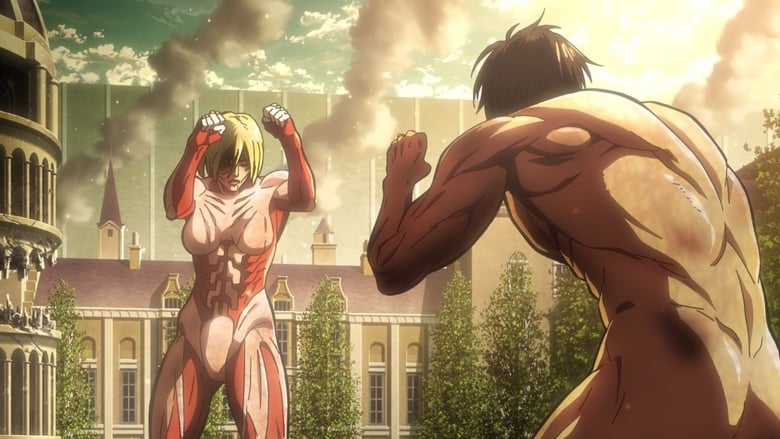
Episode 25 — “Wall: Assault on Stohess (3).” Eren and Annie fight through Stohess. Annie attempts to climb Wall Sina, but Mikasa cuts her fingers and sends her falling. Eren tears open the Female Titan's nape. Before questioning can begin, Annie seals herself inside a crystal no weapon can penetrate. Erwin accepts arrest and defends the operation as a necessary gamble, while the military counts civilian deaths.
The battle damages Wall Sina. Behind the broken surface is the face of a Titan. Pastor Nick, who recognizes the danger, urgently orders Hange to shield it from sunlight. Humanity has captured Annie but not her knowledge, and the wall itself becomes the season's final suspect.
Cast + TMDB
Cast and Characters






The gallery uses TMDB-backed Japanese voice credits and RecapRush performer profile links. It includes Marina Inoue as Armin Arlert, Yuki Kaji as Eren Yeager, Yui Ishikawa as Mikasa Ackerman, Kisho Taniyama as Jean Kirstein, Yu Kobayashi as Sasha Blouse and Hiro Shimono as Connie Springer.
Ending Explained
Is Annie the Female Titan?
Yes. Season 1 explicitly confirms it. Armin builds the case from her reaction during the expedition, the maneuver gear she presents after Sawney and Bean's deaths, and the Female Titan's familiar combat technique. The tunnel is a test: a human Titan would avoid entering a place where transformation is difficult. Annie's ring lets her draw blood and transform when the trap closes.
Why does Annie trap herself in crystal?
The season shows Annie hardening around her human body before the Scouts can interrogate her. The immediate purpose is clear: capture without disclosure. Season 1 does not explain the full mechanics, whether she can hear the people outside, or when the crystal might open. Those remain unresolved at this boundary.
Does Eren defeat Annie?
Eren overpowers her only after the Scouts, Armin and Mikasa prevent her escape. The result is a tactical victory but an intelligence failure. Annie is contained, yet the crystal preserves every answer Erwin hoped to obtain. The civilian destruction also makes “victory” politically and morally unstable.
What is the Titan inside Wall Sina?
The finale verifies only what the characters see: a Titan's face exists behind the wall's damaged surface, and Pastor Nick knows exposure to sunlight is dangerous enough to demand immediate covering. Season 1 does not explain how many such Titans exist, who placed them there, or how the walls were made. Any fuller answer would cross into later-season spoilers.
Why does Pastor Nick know about it?
His instant recognition proves the Wall religion possesses information withheld from the military and public. That turns faith into a political institution guarding material evidence. His motives and the extent of that knowledge remain open at the end of Season 1.
What does the finale change about humanity's war?
At the premiere, the walls appear to separate humans from Titans. The finale makes that map unreliable. Titan power can exist in Eren, Annie and the wall itself. The conflict is no longer simply “humanity inside, monsters outside.” It is a struggle over hidden identities, suppressed history and who controls knowledge.
RecapRush Interpretation
Season 1 repeatedly asks characters to act before certainty is possible. Hannes must decide whether to fight. Armin must decide whether the rogue Titan is useful. The tribunal must decide whether Eren is a weapon or a threat. Eren must decide whether to transform in the forest. Erwin must risk civilians on Armin's theory about Annie.
No method guarantees innocence. Trusting Levi Squad ends in grief, yet refusing all trust would make collective action impossible. Erwin's suspicion identifies a real infiltrator, yet his successful operation kills bystanders. The anime's mature insight is that a decision can be necessary without becoming morally clean.
Eren's rage protects him from despair but also narrows his imagination. He can name an enemy faster than he can understand one. Armin's strength is the opposite: he notices contradictions and keeps hypotheses provisional. Mikasa stands between them. Her clarity in battle is unmatched, but fear of losing Eren can collapse strategy into impulse. Together, the trio embody will, thought and attachment—each essential, each dangerous when isolated.
Deep Analysis & Key Themes
The walls are psychological before they are architectural
Wall Maria, Rose and Sina organize class, military authority and imagination. The farther inward people live, the easier it is to treat deaths at the edge as abstraction. The Military Police's complacency is therefore not just personal laziness; it is produced by distance. The finale's hidden Titan makes the metaphor physical. A society that buried its fear in the wall has literally built its identity around an unexamined secret.
Grief becomes three different survival systems
Eren converts grief into aggression. Mikasa converts it into control, monitoring Eren so that the family she rebuilt cannot vanish. Armin converts it into analysis, trying to make his continued survival useful enough to justify other people's sacrifices. None is simply healthy or unhealthy. Their responses save lives and create blind spots. Eren acts when others freeze; Mikasa protects when others abandon; Armin sees patterns others miss. Yet Eren can mistake hatred for truth, Mikasa can endanger a plan to protect one person, and Armin can undervalue himself until action is almost too late.
“Humanity” is a political label
The tribunal does not discover whether Eren is human through philosophy or science. It assigns him to the institution most capable of using and killing him. Once Annie is exposed, the same instability applies to every uniform. The show treats humanity less as a biological category than as a claim enforced by power, loyalty and public fear.
Bodies become contested territory
Titans grotesquely reduce people to consumable bodies. The military also treats bodies as resources: refugees are sent on a fatal operation, cadets become decoys, Eren becomes a strategic asset, and the expedition calculates acceptable loss. Hange's experiments matter because curiosity interrupts this cycle. Understanding a body can be an alternative to destroying or exploiting it—even if the institution around Hange still thinks in military terms.
Trust is a wager, not a reward for certainty
Eren's decision in the forest is often reduced to “he should have transformed.” Season 1 is more honest. He lacked enough information to know the correct choice. Levi does not promise safety; he tells Eren that nobody can know the result. Petra's bite mark shows that the experienced squad once made the same uncertain choice. Their deaths do not prove trust was foolish. They prove that ethical action cannot purchase a guaranteed outcome.
Erwin's leadership is effective because he admits its cost
Erwin withholds information, uses soldiers as bait and stages a battle in a populated district. The story neither excuses nor simplifies him. He does not claim clean hands. He accepts arrest after Stohess and argues that the discovered threat justifies continuing. His burden is not merely making hard choices; it is refusing the comfort of believing those choices become innocent because they worked.
The gaze reverses power
The season begins with humans looking up at impossible enemies. It repeatedly reverses that gaze: civilians stare at returning Scouts, the court examines Eren, Hange studies captured Titans, and Annie looks down from the wall she tries to climb. In the last image, a Titan looks outward from inside the structure humans thought they understood. The observer becomes the observed, and knowledge changes sides again.
What Most Viewers Missed
- The broken training harness previews the season's method. Eren's apparent incompetence is disproved by testing the equipment. Later mysteries are solved the same way: isolate evidence, challenge the obvious explanation, and repeat under changed conditions.
- Armin's greatest weapon is careful language. He rarely claims more than the evidence supports. He describes Eren's cannon shield as an action, not proof of permanent innocence. His Female Titan theory becomes a trap designed to test Annie rather than a public accusation based on intuition.
- Annie's final smile is not simple villainous pleasure. Within Season 1, it can be read as exhausted recognition that Armin has successfully cornered her. The scene allows sadness, relief and defiance to coexist without confirming a single private emotion.
- The child watching the defeated Scouts mirrors Eren. The returning formation looks noble to someone who cannot see the corpses or compromises behind it. The show asks whether heroic myths are lies or necessary invitations to a truth the next generation must discover for itself.
- Pastor Nick changes the genre of the central mystery. Until the finale, Titan secrets seem military and biological. His knowledge shows they are also religious and political. Someone has organized silence around the walls.
- Trost and Stohess are inverse victories. Trost wins territory while revealing Eren's Titan nature. Stohess captures a Titan shifter while revealing the wall's Titan nature. Each victory solves an immediate crisis by opening a larger one.
Mid/Post-Credits
Episode 25 includes a consequential end tag after the closing credits: light reaches the damaged section of Wall Sina and a Titan's face is visible inside. Pastor Nick's earlier demand to cover it gives the image immediate danger. It is not a joke or a promotional tease; it is the season's final piece of plot evidence. Viewers should watch through the end.
The other Season 1 episodes do not form a Marvel-style chain of post-credit scenes. Standard next-episode material and broadcast presentation can vary by platform, but the Episode 25 wall reveal is the essential verified tag.
Final Thoughts
Attack on Titan Season 1 earns its shocks because each reveal rewrites an earlier assumption. Eren's death becomes transformation. The rogue Titan becomes their friend. The intelligent enemy becomes a former classmate. The safe wall becomes a container for the thing it supposedly excludes.
Yet the season's emotional power comes from smaller reversals. A frightened child becomes a soldier; a self-described coward saves people by thinking; an elite squad admits it once doubted; a commander accepts blame instead of demanding gratitude. The finale does not answer the world's biggest question. It teaches the characters—and the audience—that every answer must be inspected for the wall built around it.
FAQ
How many episodes are in Attack on Titan Season 1?
The original 2013 first season has 25 episodes, airing in Japan from April 7 through September 29, 2013.
Who is the Female Titan in Season 1?
Annie Leonhart is the Female Titan. Armin identifies her through physical evidence, behavior and fighting style, and Episode 23 confirms the identity when she transforms.
Is Eren a Titan in Season 1?
Eren can transform into a Titan while retaining a human body and mind. Season 1 establishes the ability and links his father's basement key to missing answers, but it does not fully explain the origin of his power.
Does Annie die at the end of Season 1?
No. She seals her human body inside a hardened crystal. The Scouts cannot interrogate or extract her by the end of Episode 25.
What is revealed inside the wall?
A Titan's face is exposed within Wall Sina after the Stohess battle. Season 1 intentionally withholds the construction history and full meaning of the discovery.
Why does Levi beat Eren at the tribunal?
Levi uses the beating to persuade the court that the Survey Corps can restrain Eren. It is a calculated, brutal performance that keeps Eren alive and out of the Military Police's custody.
Why doesn't Eren transform immediately against Annie?
He struggles to accept that someone he trained with is the enemy. His power requires bodily injury and a focused purpose; emotional conflict prevents that focus until the battle has already caused severe damage.
Does Season 1 explain the Titans' complete origin?
No. It establishes human transformation, intelligent Titans, Eren's unanswered family connection and a Titan inside the wall, but the complete origin remains unresolved within these 25 episodes.
Are there later-season spoilers in this recap?
No. The discussion stops at the original Season 1 finale and treats its unanswered questions as unanswered.
Is there a post-credits scene in the finale?
Yes. Episode 25 reveals a Titan's face inside the damaged Wall Sina after the credits.
Join the conversation
What did you think of the ending? Share your interpretation. Spoilers may appear below.
This product uses the TMDB API but is not endorsed or certified by TMDB.
No comments yet. Start the conversation.