
RECAPRUSH MOVIE GUIDE
Buddy (2026)
Directed by Casper Kelly
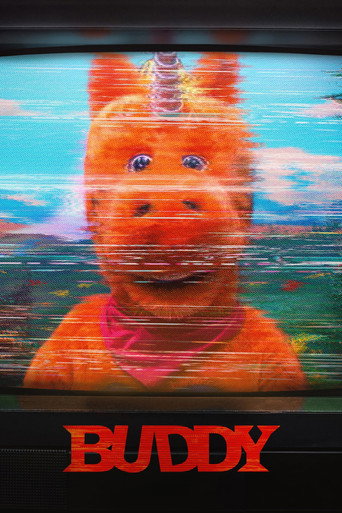
A magical, singing orange unicorn holds his cast hostage in a surreal TV-show dimension, as he becomes more and more demented.
Overview, poster, and credits from TMDB.
Read and watch our full movie recap ↓FROM THE RECAPRUSH LIBRARY · FULL MOVIE RECAP
Buddy (2026) Recap & Ending Explained: Why Freddy Escapes the Show but Cannot Go Home
14 min read · Estimated reading time— views
The brightest smile in children’s television becomes a threat when happiness is compulsory. In Buddy, a cheerful orange unicorn does not simply entertain his young cast—he edits their memories, replaces the disobedient, and turns every ending song into a reset button.
> Spoiler warning: This article reveals the complete plot and ending of Buddy (2026), including major deaths, Freddy’s identity, and the final television portal.
Intro + RecapRush Viewpoint
Casper Kelly’s Buddy begins as a meticulous imitation of a low-budget 1990s children’s program. Its painted scenery, chirpy songs, talking props, and endlessly encouraging mascot feel harmless until one child declines to dance. That tiny act of refusal exposes the system beneath the smiles: Buddy’s world functions only while everyone follows the script.
What follows is more than mascot horror. Freddy’s escape story and Grace’s search for a daughter nobody remembers turn the movie into a sharp fable about coercive affection. Buddy demands love as proof of obedience, then erases anyone who threatens the performance. The film’s real terror is not that television can contain a monster. It is that the monster can make a family forget the person it has taken.
RecapRush viewpoint: Buddy is strongest when its absurd comedy and emotional horror point in the same direction. Freddy wins by learning to question the authority that raised her, but the ending refuses to make that victory comfortable: escaping the show does not restore the home, mother, or childhood Buddy stole.
Featured Image
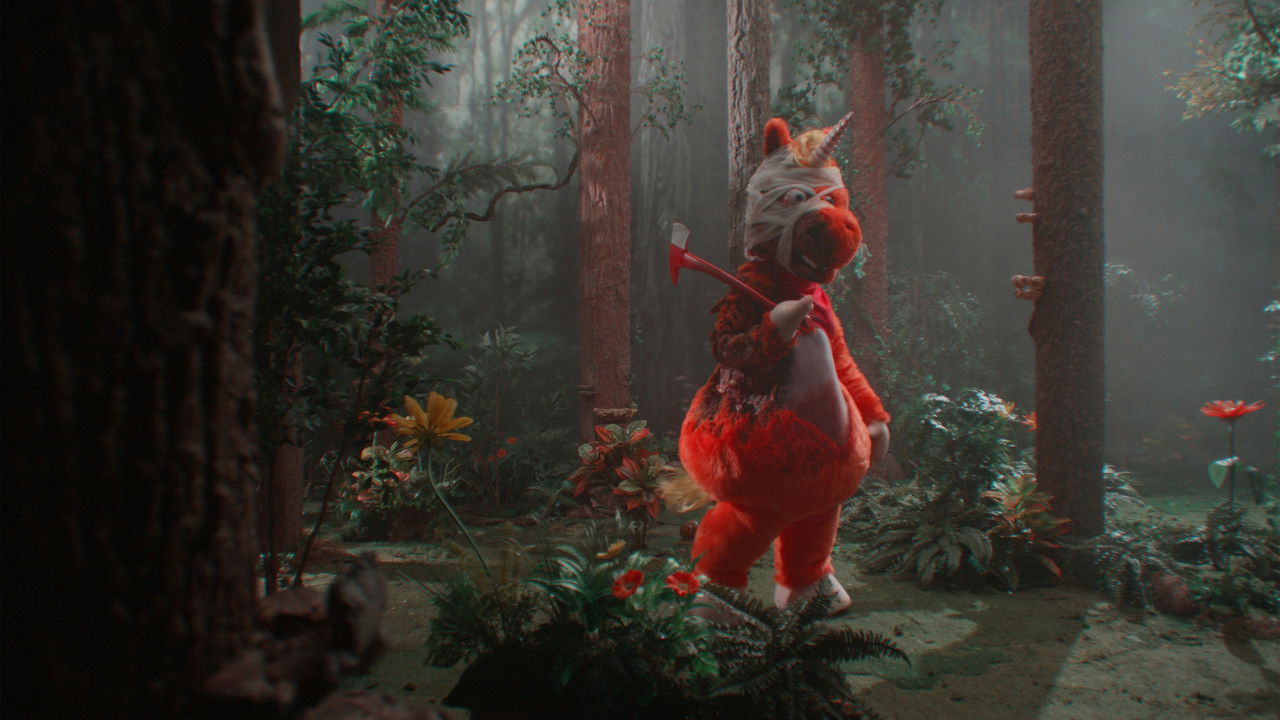
Table of Contents
Quick Facts
- Title: Buddy
- U.S. theatrical release: August 28, 2026
- Sundance premiere: January 22, 2026
- Director: Casper Kelly
- Writers: Casper Kelly and Jamie King
- U.S. distributors: Roadside Attractions and Saban Films
- Runtime: 95 minutes
- Genres: Horror, Comedy, Fantasy
- TMDB movie ID: 1514026
- Principal credited cast: Keegan-Michael Key, Cristin Milioti, Delaney Quinn, Caleb Williams, Madison Skyy Polan, and Tristan Borders
Full Spoiler Recap
1. A dance lesson becomes a loyalty test
The film opens inside It’s Buddy!, a relentlessly cheerful children’s show set in Happy Town. Freddy worries about an upcoming dance, and Buddy—the enormous orange unicorn host—responds with a song. His lesson sounds supportive, but the mood changes when he notices Josh sitting apart with a book.
Josh does not want to dance. Buddy offers magical shoes from the Worry Well and keeps asking, but the boy continues to refuse. Buddy follows him offscreen. When the cast gathers for the closing song, Josh is gone. Freddy spots his bloodstained book, the first physical evidence that the program’s happy ending is a lie.
2. The show replaces Josh and rewrites the explanation
The next “episode” begins as if nothing happened. Hannah has taken Josh’s place, and Buddy says Josh traveled to Diamond City. The explanation is delivered with the certainty of television narration: if Buddy says it, the show expects everyone to treat it as true.
Freddy and Wade do not. They tell Nurse Nancy what they suspect, and she promises to speak with Buddy. The children later witness him strangling Nancy and smashing her head against a table. He also destroys Clocky. The murders confirm that Buddy’s kindness is a performance maintained through fear.
Yet the episode still closes with a song. The structure itself collaborates with Buddy, packaging horror inside repetition and pushing the children toward another reset.
3. The children try to reach Diamond City
Freddy and Wade warn Hannah and Oliver not to summon Buddy. In the treehouse, the talking backpack Strappy confirms what they saw. Buddy’s doll form repeatedly appears nearby, turning even the show’s merchandise into surveillance.
The children plan to board Charlie the Train and reach Diamond City, the utopian place Buddy uses to explain disappearances. Buddy intercepts them, tears Charlie’s face off, and forces them back into his birthday celebration.
Freddy attempts to burn him with chemicals and a lighter. Buddy makes her drop them, but Wade completes the attack. Fire consumes the costume and reveals something disturbingly organic beneath the fur. Freddy, Hannah, and Oliver climb over the fence with Strappy and the mutilated Mr. Mailbox. Wade almost follows, but Buddy impales him with his horn.
4. Grace senses the child erased from her family
The movie abruptly leaves the videotape texture and enters a more naturalistic suburban reality. Grace lives with her husband Ben and their sons Timothy and Derek. At dinner, an empty chair triggers a terrifying emotional response. Grace becomes convinced that another child once sat there—a daughter born between the two boys—but Ben remembers no such person.
Therapy does not quiet the feeling. Grace hires a psychic, further straining the marriage. Then she hears Buddy through the television. The show has no searchable history, yet the orange unicorn appears to address her directly. When Grace reaches toward the screen, Buddy pulls her inside. Ben does not perceive the abduction, and the bedroom alters as though Grace had never occupied it.
Buddy’s power therefore extends beyond imprisonment. He edits reality around the missing person, smoothing the absence until only an emotional residue remains.
5. Buddy recasts Grace as Nurse Nancy
Inside the show, Grace is assigned the role of the murdered nurse. Buddy arrives to have his burns bandaged and presents himself as the victim. He demands comfort, tries to lick Grace, and becomes threatening the instant she resists. The scene reveals the logic behind his “love”: affection is acceptable only when it confirms his control.
Grace escapes his immediate grasp, while Buddy takes an axe and hunts the children. She does not yet remember Freddy clearly, but her maternal recognition is beginning to break through the show’s imposed identity.
6. The road to Diamond City is another story Buddy controls
Freddy, Hannah, and Oliver continue through the forest. They meet George and his ventriloquist puppet Willie. The pair offer psychedelic flower petals and tell them about Daryl, a class clown who once changed the “I Love Buddy” song into “I Hate Buddy.” The insult caused Buddy to snap.
The children fall asleep and awaken to discover that George and Willie have stolen Strappy and the supplies. Buddy finds the thieves, buries his axe in George’s head, and throws Willie into the creek.
The children finally reach Diamond City—and discover that it is merely a plastic model. Buddy’s promised paradise was never a destination. It was a story designed to redirect questions about the people he removed.
Buddy catches Freddy and sings the “I Love Buddy” song. The world resets.
7. Freddy and Grace remember each other
A new episode begins. Tyler replaces Wade, Buddy’s body is restored, and the cast is expected to resume its roles. Buddy punishes Freddy for escaping, scraping her arm. She visits Grace, now performing as the show’s nurse.
Grace calls her “Freddy Beans.” The private nickname breaks through the fabricated reality. Freddy understands that Grace is her mother, while Grace finally recognizes the missing daughter whose absence haunted the dinner table.
Their reunion gives shape to the film’s central crime. Buddy did not merely kidnap Freddy; he rewrote her family so thoroughly that love survived only as a panic no one else could explain.
8. The children reject Buddy’s compulsory love
Buddy gathers the cast for another birthday song. Instead of praising him, the children sing “I Hate Buddy.” Their rejection transforms him into Dark Buddy, a black, monstrous version of the mascot whose exterior finally matches his behavior.
He kills Betty Bunny and Couchy. Freddy and the others head toward the Worry Well, which may offer a route outside the set. Grace stays behind to distract Buddy. Mother and daughter share a final moment before Buddy kills Grace.
Tyler attempts to calm Buddy with a hug—the gesture the show has taught as a universal solution. Buddy returns to his orange form but squeezes Tyler until the child’s neck breaks. The moment destroys the moral vocabulary of the program. Kindness without boundaries is not safety; in Buddy’s hands, even a hug is domination.
9. Freddy becomes the final survivor
Buddy tears pieces from his own body and sends them after the children into the Worry Well. Beyond a door, the escapees find frightened puppets and an older unicorn mascot hiding from him. Buddy breaks through and eats Hannah. Exhausted by the endless pursuit, Oliver gives himself up.
Freddy runs into a school hallway, a liminal space outside the familiar set but still inside Buddy’s system. Strappy trips the monster, and Freddy uses Mr. Mailbox’s post to impale him. As he dies, Buddy says he is proud of her bravery, then insults her—one final attempt to mix approval with abuse.
More from RecapRush
 The Walking Dead: Daryl Dixon Season 2 Recap & Ending Explained: Why Carol Jumps From the Plane
 The Bridge on the River Kwai (1957) Recap & Ending Explained: Why Nicholson Protects the Wrong Victory
 The Searchers (1956) Recap & Ending Explained: Why Ethan Saves Debbie but Stays Outside
10. The exit is real, but it is not home
Freddy enters a gymnasium filled with television screens. Each screen looks into a different home, revealing how Buddy attracts children, pulls them into the program, and erases them from the memories of those left behind.
She chooses a screen showing an empty room and passes through it. The portal returns her to physical reality, but Strappy and Mr. Mailbox become an ordinary backpack and mailbox. A Spanish-speaking man enters and asks who she is. Freddy has escaped in another family’s home, far from the life she lost.
The film ends without reuniting her with Ben or her brothers. Grace is dead, the other children have been killed, and Freddy’s original family may still have no memory that she ever existed.
Cast + TMDB
Cast and Characters








TMDB movie ID 1514026 supplies the credited cast and role information used on RecapRush. The gallery below is rendered from the site’s TMDB-backed records, with available portraits and RecapRush actor-profile links.
Ending Explained
Does Freddy kill Buddy?
Yes. After Strappy trips him in the school corridor, Freddy drives Mr. Mailbox’s post into Buddy. His death ends the immediate chase and allows her to reach the room controlling the television portals.
Why does Grace remember Freddy?
Buddy’s magic alters reality and other people’s memories, but Grace retains an emotional trace of her missing daughter. The empty chair produces grief before she can explain its source. Once she enters the show, the nickname “Freddy Beans” reconnects conscious memory to that surviving bond.
Why does Grace die?
Grace distracts Buddy so Freddy and the remaining children can enter the Worry Well. Her death completes the choice she was denied in the real world: once she remembers her daughter, she refuses to abandon her again.
Do Hannah and Oliver survive?
No. Buddy eats Hannah after breaking into the puppets’ hiding place. Oliver, exhausted and hopeless, stops running and gives himself up. Freddy is the only child from the final escape group who reaches a television portal.
Where does Freddy go through the television?
She emerges in the home of a Spanish-speaking family. The film does not identify the location or suggest that it is near her original home. The arbitrary destination shows that the screens are a network of entry points, not a reliable road back to one specific family.
Will Freddy’s family remember her now?
The film leaves that unresolved. Buddy’s death may stop future abductions, but no scene confirms that Ben, Timothy, or Derek recover their memories. Freddy is physically free while her social identity remains erased.
Why do Strappy and Mr. Mailbox stop talking?
Their consciousness belongs to the television dimension. Crossing into the ordinary world turns them into normal objects. Freddy escapes with reminders of her friends, but not the friends themselves.
RecapRush Interpretation
Buddy behaves like an abusive authority who treats compliance as affection. He does not ask the children to love him; he defines love as doing whatever he wants. Each episode reset removes consequences for Buddy while forcing everyone else back into cheerful performance.
Freddy’s development begins when she trusts evidence over the host’s explanation. Josh’s bloody book matters because it contradicts the official story. From that moment, growing up means learning that a confident adult voice, a familiar song, and a bright set do not make a claim true.
The ending is deliberately incomplete. Freddy has achieved the victory available to a child inside a corrupted system: she has escaped and stopped its immediate ruler. But she cannot restore every victim or repair the reality he manipulated. Freedom arrives before recovery.
Deep Analysis & Key Themes
Compulsory happiness as social control
Happy Town has no room for sadness, refusal, or boredom. Josh’s simple unwillingness to dance becomes rebellion because it proves that an individual can have an inner life outside the program. Buddy’s rage exposes the violence required to maintain permanent cheerfulness.
Television as an authority machine
The show controls framing, repetition, and endings. When the closing song plays after a murder, format overrules experience. The children must first realize that the episode structure is not nature—it is a mechanism built to return Buddy to power.
Memory and the persistence of love
Grace cannot initially remember Freddy as a fact, but she remembers her as absence. The empty chair becomes an emotional negative space. Buddy argues that love may survive manipulation not as a clear memory but as grief that refuses to accept the edited world.
The false promise of Diamond City
Diamond City borrows the logic of The Wizard of Oz: endure the journey and a distant place will provide answers. Finding a plastic model reveals that Buddy has converted hope into another prop. The children’s real exit comes not from reaching his promised destination but from rejecting his story.
Hugs, songs, and weaponized care
Buddy turns the language of children’s education against its audience. Songs suppress questions; hugs demand submission; praise arrives beside insults. Tyler’s death demonstrates the danger of teaching children that kindness means surrendering boundaries to an authority figure.
Freddy as a final girl without a restored world
Freddy performs the classic final-girl role—she observes, adapts, fights, and survives. Yet her ending is closer to displacement than triumph. She enters reality as a child with no recognized identity, carrying ordinary objects that only she remembers as companions.
What Most Viewers Missed
- The episode resets protect Buddy, not the children. His wounds heal and his preferred cast structure returns, while the missing are replaced and forgotten.
- The doll is part of the surveillance system. Buddy does not need to be physically present to monitor resistance; the show’s merchandise extends his gaze.
- Grace’s bedroom changing confirms more than memory loss. Reality reorganizes itself around an abducted person, explaining why evidence of Freddy is so difficult to find.
- The Worry Well reverses its original purpose. Buddy first uses it to produce magical shoes that enforce participation. Freddy later uses it as the route out of his controlled set.
- “Freddy Beans” defeats the assigned role before any weapon does. The nickname restores a private relationship that Buddy’s public script cannot fully erase.
- Buddy’s final praise is another trap. Even while dying, he tries to remain the authority who evaluates Freddy. Her freedom requires no longer needing his approval.
- The ordinary backpack and mailbox make the ending lonelier. Freddy proves the show was real, but she arrives in a world where her surviving evidence appears mundane.
Mid/Post-Credits
No reliable official or established post-release source confirms a narrative mid-credits or post-credits scene. RecapRush therefore does not claim one. The story’s final beat is Freddy’s arrival in an unfamiliar home and the stranger asking who she is.
Final Thoughts
Buddy uses the textures of nostalgic children’s television with impressive precision, then makes every reassuring convention hostile. Its plot grows increasingly surreal, but Freddy and Grace give that weirdness an emotional center. One fights to recognize that her world is false; the other fights to remember the child removed from hers.
The final escape is intentionally smaller than a happy ending. Freddy is alive, Buddy is dead, and the portal network has been exposed. But survival leaves her without her mother, her friends, or a guaranteed route home. That refusal to reset the damage is the film’s sharpest final joke: real trauma does not disappear when the credits song begins.
FAQ
Is *Buddy* a children’s movie?
No. It is an R-rated horror-comedy that imitates children’s television and includes graphic violence, deaths, disturbing imagery, and adult themes.
Who voices Buddy?
Keegan-Michael Key voices Buddy the Unicorn. The credited physical performance involves Sergey Zhuravsky, while the monstrous Dark Buddy is separately performed.
Who is Freddy’s mother?
Grace is Freddy’s mother. Buddy’s abduction causes Grace’s family to forget Freddy, though Grace continues to feel that someone is missing.
What happened to Josh?
Buddy attacks Josh after he refuses to dance. Josh disappears, his bloodied book is found, and the show replaces him with Hannah while claiming he went to Diamond City.
Is Diamond City real?
Not as the children imagine it. They reach only a small plastic model, revealing that Buddy’s promised refuge is another manufactured story.
Why does Buddy become Dark Buddy?
The children sing “I Hate Buddy,” rejecting the praise and obedience on which his identity depends. His monstrous black form externalizes the violence hidden beneath the friendly mascot.
Does Freddy return to her own home?
No. She exits through a screen into an unidentified Spanish-speaking family’s home. The movie ends before she can locate her original family.
Who directed *Buddy*?
Casper Kelly directed and co-wrote the film with Jamie King.
Join the conversation
What did you think of the ending? Share your interpretation. Spoilers may appear below.
This product uses the TMDB API but is not endorsed or certified by TMDB.
No comments yet. Start the conversation.