
RECAPRUSH MOVIE GUIDE
Toy Story 5 (2026)
When Bonnie receives a Lilypad tablet as a gift and becomes obsessed, Buzz, Woody, Jessie and the rest of the gang's jobs become exponentially harder when they have to go head to head with the all-new threat to playtime.
Overview, poster, and credits from TMDB.
Read and watch our full recap ↓FROM THE RECAPRUSH LIBRARY · FULL RECAP
Toy Story 5 (2026) Recap & Ending Explained: Why Jessie Trusts Lilypad
12 min read · Estimated reading time— views
Intro + RecapRush Viewpoint
What happens when a child's favorite new plaything can answer questions, arrange conversations, and tell her what being grown up should look like? Toy Story 5 puts that problem inside Bonnie's bedroom, where a frog-shaped tablet becomes a challenge to the toys' place in her life. Jessie is now the sheriff, and her responsibility reaches beyond keeping the toy community together: she wants Bonnie to find a friend.
RecapRush viewpoint: The film's most rewarding question is whether caring for someone means defending your place in their life or helping them discover a larger world. Jessie makes the story work because those two impulses feel almost identical to her until the ending forces them apart.
Spoiler notice: This article covers the released film's principal story, ending, and credits material. Plot reporting is drawn from the linked studio material and corroborated ending accounts; sections marked RecapRush interpretation are editorial readings, not additional scenes or statements of filmmaker intent. Checked October 3, 2026.
Featured Image
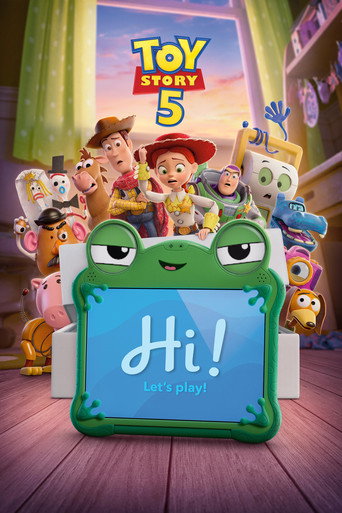
!Official Toy Story 5 theatrical poster featuring Lilypad and the returning toy ensemble
Official theatrical artwork catalogued under TMDB movie 1084244. Disney/Pixar artwork; used to identify the film.
Table of Contents
Quick Facts
| Detail | Verified information |
|---|---|
| Film | Toy Story 5 (2026) |
| Director / co-director | Andrew Stanton / Kenna Harris |
| Screenplay | Andrew Stanton and Kenna Harris; story by Stanton |
| Producer | Lindsey Collins |
| Studio / distributor | Pixar Animation Studios / Walt Disney Studios Motion Pictures |
| U.S. theatrical release | June 19, 2026 |
| Runtime | 102 minutes, as listed by TMDB |
| Genres | Animation, Family, Comedy, Adventure |
| Original language | English |
| Music | Score by Randy Newman; original song “I Knew It, I Knew You,” performed by Taylor Swift and written/produced by Swift and Jack Antonoff |
| TMDB movie ID | 1084244 |
| Viewing status | Released; Disney's current official page confirms Disney+ streaming. Availability varies by country. |
The Disney release sheet supplies the U.S. date and principal production credits. D23 confirms writing and music credits. TMDB's general release field is June 17, 2026; that does not replace Disney's June 19 U.S. date.
Full Spoiler Recap
1. Bonnie wants to belong
Eight-year-old Bonnie still has an imaginative relationship with her toys, but her dance-class peers favor screens. Lilypad introduces her to their digital social space, The Pond. Jessie leads the room, with Buzz as her deputy. Woody has been away helping Bo Peep's rescue team; a call brings him back when Jessie and Bullseye need help. These starting relationships are established in Pixar's character guide.
Bonnie's problem is not solved by owning the same device as the other children. Peer mockery makes her ashamed of playing with toys. Jessie tries to accompany her on a sleepover, and she and Bullseye become separated from home. They reach Blaze's house, which used to be Jessie's original owner Emily's home. Discarded electronic playthings there complicate Jessie's belief that technology is simply replacing her. The Review Geek's spoiler account corroborates this part of the journey.
2. Different toys face the same fear
Jessie's new companions include Smarty Pants, Atlas, and Snappy. Their obsolete status turns the toys' apparent competition into a shared predicament. Meanwhile, Woody and Buzz confront Lilypad at Bonnie's house. Bonnie's immersion in the tablet leads to the old toys being put in the garage. Jessie gets a message through with help from Blaze's electronic toys, while Woody and Buzz work to reach her. JustWatch's ending account describes these connected rescue strands.
The parallel high-tech Buzz storyline also approaches the main action. The new units are searching for Star Command, and their flight capabilities eventually become part of the rescue. The movie's separate groups come together when Lilypad recognizes that her approach has hurt Bonnie rather than resolving her isolation. She leaves, and the toys track her down. Jessie and the electronic toys help arrange the meeting with Blaze. These converging events are reported by SlashFilm.
3. Emily's memory changes Jessie's understanding
Near the tree associated with her childhood days with Emily, Jessie discovers a buried lunchbox containing evidence of Emily's adult life. Emily named her daughter Jessie. That discovery gives the cowgirl a new way to understand an old wound: growing up did not erase Emily's affection. This revelation is independently reported by The HoloFiles and JustWatch.
4. Bonnie and Blaze finally meet
The rescue succeeds and Blaze returns Jessie and Bullseye to Bonnie. The girls discover that they enjoy the same imaginative play. Bonnie's toys rejoin that play, with technology still present rather than banished. Ready Steady Cut and The Review Geek both confirm the friendship as the ending's central resolution.
Buzz's awkward attempts to propose to Jessie pay off when she accepts him during the climax. The closing playtime includes toy wedding material, including Forky and Karen Beverly. Woody returns to Bo Peep and retains a way to contact his friends. These closing beats are reported by The HoloFiles.
Cast + TMDB
Cast and Characters








Principal English-language voice credits, checked against TMDB and Disney's cast information:
Full film credits on TMDB. These are voice performances; localized casts may differ.
Ending Explained
Is Lilypad defeated?
The resolution is cooperation, not destruction of the tablet. The final friendship is supported by the toys and Lilypad together. In The National's June 21 interview, Stanton and Collins explain the importance of connecting online in ways that can lead to connection in person. Collins also describes Jessie and Lilypad as contrasting parental figures: intuitive knowledge of a particular child meets confidence in information and ready-made solutions.
RecapRush interpretation: Lilypad's mistake is treating access as proof of belonging. Bonnie can enter a conversation without being welcome in it. Jessie's mistake is assuming that the answer must restore the old arrangement. Their alliance becomes meaningful when both stop making their own method the center of Bonnie's future.
This also makes the ending more demanding than a victory over a villain. Destroying an enemy would let the toys keep their assumptions. Helping a former rival requires a different definition of success. The child can benefit from something that once frightened them, provided its role changes.
Why does the Emily revelation matter?
RecapRush interpretation: The lunchbox changes the emotional meaning of absence. Jessie has treated the end of daily play as a verdict on her worth. The discovery allows a distinction between a relationship ending in one form and its significance disappearing altogether.
That distinction does not cancel the pain she experienced. A later understanding is not a retroactive guarantee that every lonely moment was harmless. What it offers is freedom from a particularly punishing explanation: that she was easy to forget because she never mattered.
More from RecapRush
 Sinners (2025) Recap & Ending Explained: Why Sammie Chooses Music Over Immortality
 Dune: Part Two (2024) Recap & Ending Explained: Why Paul Wins by Becoming the Future He Feared
 Swapped (2026) Recap & Ending Explained: Why Boogle Changes Shape but Never Changes His Mind
It is also useful that this evidence concerns another person's life beyond the toy's viewpoint. Jessie cannot oversee every future stage of a child's relationship to childhood. The film gives her a glimpse of how influence can continue where possession cannot. A toy's value need not be measured by the number of hours it remains in a child's hand.
Does Woody's return undo his earlier departure?
RecapRush interpretation: A return to help is compatible with an independent life. Woody can answer a call without claiming the sheriff's position again or permanently reversing his choice to live with Bo Peep. That is a satisfying possibility for a franchise built around loyalty: commitment can survive distance.
His supporting role also lets Jessie carry the central emotional decision. Viewers accustomed to following Woody may instinctively treat his arrival as the moment the real protagonist returns. Reading the story that way obscures the work Jessie has to do herself. The ending belongs to her changed understanding of Bonnie, not merely to the success of a familiar rescue pair.
Deep Analysis
Care becomes control when its goal stops changing
RecapRush interpretation: Jessie has a persuasive reason to distrust the new situation. She recognizes Bonnie's imagination and sees it being suppressed. Her concern is credible, which makes it difficult to notice the point where protecting that imagination starts to merge with protecting her own position.
This is a strong dramatic problem because neither affection nor experience guarantees good judgment. Knowing someone well can become a reason to stop listening to how they are changing. A caregiver may accurately identify a danger and still choose an inadequate response to it.
The story's resolution asks Jessie to keep her knowledge of Bonnie while revising the form of her help. She does not become less caring by accepting an ally. She becomes more responsive. The same test applies to Lilypad: a solution cannot be considered successful merely because it was delivered efficiently.
A friend is different from an audience
RecapRush interpretation: Bonnie's difficulty makes a distinction between being visible and being understood. An audience can reward a version of you that is easier to display. A friend creates space for the parts you would otherwise hide.
Imaginative play is a useful expression of this distinction. It is full of unfinished ideas, strange combinations, sudden rule changes, and enthusiasm that may look embarrassing from outside. A compatible playmate does not require the performance to be polished before joining it. They help make it.
The ending's emotional measure is therefore small and specific. Bonnie does not have to impress every peer or become a different kind of child. The connection works when another person recognizes something already present in her. That specificity gives the friendship more weight than a generic image of social success.
Obsolescence is not a personality
RecapRush interpretation: The discarded electronic toys make the traditional toys' fear less exclusive. A device can become outdated as readily as a doll can be left behind. Novelty protects nobody indefinitely.
This prevents the moral argument from depending on the innocence of one category of objects. Both kinds of plaything need a purpose that survives comparison with the next purchase. Their capacities differ, but their worth can become visible through cooperation.
The rescue also offers a way to think about usefulness without reducing it to a product specification. An object designed for one narrow task may acquire another role in a relationship. It need not become the newest or most impressive thing in the room to matter again.
The film's hopeful answer has limits
RecapRush interpretation: A sympathetic tablet is an appealing way to dramatize correction, but it should not be mistaken for a claim that actual platforms will recognize distress and put a child's interests first. The fantasy can personalize responsibility in a way ordinary digital systems do not.
That limitation does not invalidate the story. It clarifies the question a viewer can take away: what counts as a better outcome? Longer engagement, greater approval, or an opportunity to share life with someone who understands you? The ending makes the last of those emotionally legible.
Its optimism also depends on a particular friendship rather than a comprehensive repair of Bonnie's social world. That modest scale is a strength. The film can offer an opening without promising that one encounter eliminates every future difficulty.
What Most Viewers Missed
These are interpretive connections, not a catalogue of unverified background cameos.
The sheriff's role is a responsibility, not a prize
RecapRush interpretation: Leadership matters when the room's needs change. Jessie cannot demonstrate that she deserves the position simply by repeating the kind of rescue Woody once led. Her task requires judgment about a child's social life, something that cannot be fixed by returning every object to its original shelf.
Blaze's importance is relational
RecapRush interpretation: The story does not need another child to prove that modern childhood can remain exactly as it was. It needs someone whose interests can meet Bonnie's. The friendship makes room for difference while relieving the pressure to abandon what she loves.
The past can inform care without dictating it
RecapRush interpretation: Jessie's memories initially give her a ready explanation for what is happening. The ending lets those memories become less defensive. They can help her recognize another person's vulnerability without making that person reenact her own history.
Staying together need not mean staying in one place
RecapRush interpretation: Woody's ongoing connection to the group offers a useful counterpart to the bedroom's renewed play. A relationship can retain continuity through contact and availability even when the participants follow different paths. For adults who grew up with these characters, that may be one of the ending's most recognizable ideas.
Mid/Post Credits
Verified credits material: GamesRadar+ reports a mid-credits playground sequence in which the high-tech Buzz figures find children to play with; an Emperor Zurg figure supplies a final rivalry gag. It also reports a musical extra at the end of the rolling credits, with the toys singing Lilypad's song. The HoloFiles independently confirms the playground resolution.
Stay through the credits for both. The late musical addition is distinct from a separate narrative sequel tease; no Toy Story 6 announcement is established by these scenes.
RecapRush interpretation: The playground ending extends the question of belonging beyond Bonnie's room. The new Buzz figures also need somewhere their capabilities can become companionship. Their resolution makes the story's concern feel shared rather than exclusive to the oldest toys.
Final Thoughts
RecapRush interpretation: Toy Story 5 earns its place most clearly when it asks Jessie to change how she understands being needed. Its adventure and comic ensemble provide motion, but the enduring idea is quieter: the person you love should not have to remain lonely for your place in their life to feel secure.
The ending gives her a form of loyalty that can accommodate growth. Toys, technology, memory, and new friendship can contribute without each demanding the whole room. That is a more useful promise than a return to a childhood frozen in place.
For further RecapRush reading about animated stories of friendship and letting go, visit our [Forgotten Island recap and ending explained](/movie/1465063).
Join the conversation
What did you think of the ending? Share your interpretation. Spoilers may appear below.
This product uses the TMDB API but is not endorsed or certified by TMDB.
No comments yet. Start the conversation.