
RECAPRUSH MOVIE GUIDE
One Last Shot (2026)
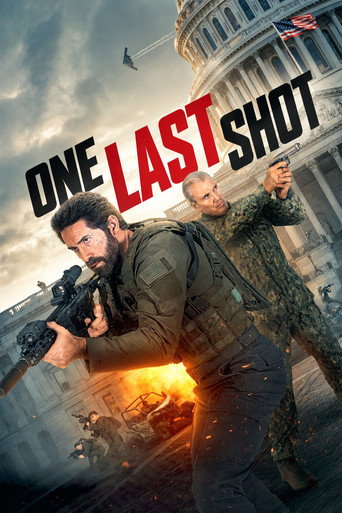
Navy Seal Jake Harris must stop a team of mercenaries, led by his disillusioned former comrade, from disabling the US missile defense network.
Overview, poster, and credits from TMDB.
Read and watch our full recap ↓FROM THE RECAPRUSH LIBRARY · FULL RECAP
One Last Shot (2026) Recap & Ending Explained: Why Jake Refuses Carter's Definition of Loyalty
17 min read · Estimated reading time— views
Intro + RecapRush Viewpoint
One Last Shot brings Navy SEAL Jake Harris back into combat before he has recovered from the first two films. A former comrade, Elliot Carter, has seized the Joint Chiefs of Staff and needs their biometric data—plus one final authorization from NSA deputy director Elena Torres—to compromise the United States missile-defense network. Jake is sent into the Blue Ridge Mountains with an FBI hostage-rescue team, but his private order is not simply to stop Carter. It is to make sure his old friend never reaches a courtroom. [1, 3, 5]
RecapRush Viewpoint: Carter and Jake have both been used by the same institutions, but the ending refuses to treat shared injury as shared morality. Carter turns betrayal into permission to sacrifice strangers; Jake breaks with both Carter and his own chain of command when saving lives conflicts with finishing the mission cleanly.
Full spoilers ahead. This recap covers Carter's takeover, the failed extraction, the airstrike, the missile-defense shutdown and Jake's final call home. Plot details were checked against Sony's official synopsis, contemporary reviews and the English release subtitles. Interpretation is labeled separately. Identity and release information checked October 4, 2026.
Featured Image
Table of Contents
Quick Facts
- Title: One Last Shot
- Director: James Nunn
- Writer: Jamie Russell
- Digital and DVD release: September 22, 2026
- U.S. distributor: Sony Pictures / Destination Films
- Production banner: Signature Films
- Runtime: 98 minutes on TMDB; Apple TV and IMDb list approximately 97 minutes
- Genres: Action, thriller
- Country/language: United Kingdom; English
- Rating: R for strong violence and language in the U.S.
- Principal cast: Scott Adkins, Steven Cree, Hannah Ware, Dolph Lundgren and Kane Kosugi
- TMDB movie ID: 1607127
- IMDb ID: tt37971717. [1, 2, 4]
This is the third Jake Harris film after One Shot (2021) and One More Shot (2024). Like those movies, it is staged and edited to feel like one continuous take. The story begins only hours after the previous installment, so Jake's wounds and exhaustion carry directly into this mission. [3, 5, 6]
Full Spoiler Recap
1. The previous attacks were preparing a larger target
The attempted dirty-bomb attack during the State of the Union creates exactly the national-security response Carter needs. Senior military officials are moved together to a supposedly secure compound in the Blue Ridge Mountains. The facility combines an old Cold War site, a manor and a modern command area linked by tunnels. [5, 6]
The earlier crisis was therefore not the final objective. Bringing the Joint Chiefs into one controlled location gives Carter access to the people whose biometrics can open protected systems. His private military network, Farbridge, has recruited veterans and penetrated multiple agencies. The danger is not only that the building has been attacked; the systems meant to respond may already contain his people.
2. Carter takes the Joint Chiefs hostage
Inside the compound, the officials and their aides are asked to surrender personal devices during a communications blackout. Elena Torres, a deputy director at the NSA, becomes suspicious when she realizes Carter is present. Carter reveals himself to the room and explains that he once served under General McManus in Afghanistan. [7]
He frames the takeover as a revolt against leaders who sent soldiers to die for lies. His men overpower the guards, but Carter orders them to keep the Joint Chiefs alive because he needs their biological authorization. Elena escapes the initial seizure with help from staff members, gets a warning outside the compromised chain and hides somewhere on the grounds. Carter now has most of the keys he needs, but the system cannot be fully accessed without her.
3. Jake is denied the trip home he was promised
Jake arrives bruised, bandaged and barely rested after the events of One More Shot. A medic says he should be in an emergency room. Admiral Mulholland instead wakes him for another operation. Jake hears a worried message from Kelly, who has seen reports of the attacks and wants confirmation that he is alive. [5, 7]
Mulholland tells Jake that Carter—a former SEAL and Defense Department contractor—is behind the hostage crisis. An FBI Hostage Rescue Team will enter the compound to extract Elena. Jake is added as a consultant because he knows Carter, but Mulholland gives him a second mission: Carter must leave in a body bag. A public trial involving a decorated SEAL turned domestic terrorist would damage the institution.
Jake resists. Carter once saved his life, and Jake had been told he was finally going home. Mulholland invokes the danger to American families and says Jake is the only operator he trusts, even while admitting that the operation officially does not exist. Jake joins Special Agent Robinson's team with conflicting obligations—to stop the attack, save Elena and execute the man he still feels he owes.
4. The rescue team enters through the old tunnel system
Robinson's team approaches through woods and a ravine, crosses the perimeter and searches for a tunnel into the compound. Jake warns that Farbridge employs former U.S. service members. The team is therefore moving against people trained in many of the same methods. [7]
The supposedly secret route has already been prepared as a kill zone. A tripwire blocks part of the tunnel, and other traps slow the advance. Upstairs, Carter's people continue collecting biometric data from the captives. The film's continuous-take design follows the team through confined rooms and passages without giving Jake a clean break from one threat before the next arrives. [3, 5]
5. The pressure-plate trap fractures the operation
One team member steps onto a pressure-sensitive explosive and cannot move without triggering it. Jake stays close and tries to help while Carter's mercenaries take the high ground and fire down into the trapped team. The rescuers have to fight while protecting a man who cannot change position. [5, 6]
The firefight destroys the operation's original shape. Casualties mount, communications become unreliable and the rescuers are separated. Jake is forced to keep moving through the compound with little certainty about who remains alive. The mission that was planned as an extraction becomes an improvised effort to prevent Carter from completing his access sequence.
6. Elena tries to save the hostages before herself
Elena discovers surviving captives and initially tries to free them. They tell her that Carter is hacking the missile-defense network and that she is the final person he needs. Because the conspirators require the officials alive long enough to capture their biometrics, the prisoners urge Elena to escape toward a lake on the west side of the base and call for help. [8]
She reaches emergency services and reports that the Joint Chiefs are being held, but Carter's men close in. Jake finds her during the pursuit. Elena challenges his condition and his plan, yet she follows him because he is the only remaining route out. Jake initially decides that getting her to safety matters more than personally hunting Carter.
7. Jake fights Lee and is taken to Carter
The escape puts Jake against Lee, one of Carter's most capable fighters. Their encounters shift the action from gunfire to close combat, forcing the already injured Jake to fight someone who can match his speed and training. Carter's men eventually recover Elena and overwhelm Jake. [3, 6]
When Jake is brought before Carter, the reunion is initially intimate rather than theatrical. Carter asks about Kelly and the children. He remembers their service together, and Jake admits that Mulholland sent him to kill Carter. Carter uses that order as evidence for his argument: the institution cares more about its reputation than the veterans who bled for it.
8. Carter explains how grievance became his army
Carter's force is made up largely of veterans who believe they were abandoned after serving. He points to their histories and asks Jake to see them as brothers betrayed by political leadership. Carter also reminds Jake that he once took a bullet for him. Loyalty, in Carter's account, belongs to the person beside you rather than the government that issued the order. [8]
Jake understands the grievance but rejects the conclusion. Carter's operation will expose civilian families to catastrophic attack. He has also used people as expendable pieces, including Mansur from the earlier plot. When Carter pressures Jake to warn Kelly, the gesture is not mercy: it brings Jake's family into the room as emotional leverage and demonstrates how far Carter will intrude to win.
9. Mulholland chooses an airstrike over the hostages
As the rescue collapses, the government authorizes a B-2 strike on the compound. The order will destroy the evidence and prevent the system breach, but the Joint Chiefs and other captives are still inside. Jake reports that the hostages are alive and begs Mulholland to stop the bombing. Mulholland insists that the priority is Carter and even authorizes Jake to kill Elena if necessary. [8]
This is the moment when Jake's two sources of authority converge. Carter claims that institutions sacrifice soldiers and civilians for political objectives; Mulholland proves willing to do exactly that. Yet Carter is also preparing a mass-casualty attack. Jake cannot solve the contradiction by simply joining either man. He abandons the assassination logic and acts around a narrower principle: protect the people who are still alive.
10. Carter takes Elena toward the network connection
Carter withdraws with Elena while the incoming strike reduces the remaining time. Vehicles race from the compound toward the lake, where a boat and wired network access are waiting. Jake follows by ATV and buggy through Carter's retreating force. [3, 8]
The chase is not merely an escape. Carter needs Elena physically present so the system will accept the final user. Jake must reach them before the shutdown command is confirmed, while the bomber is also closing on the site behind him.
11. Jake and Carter make opposite choices
At the last terminal, Carter forces the biometric process toward completion. He urges Jake to stand with him, treating their shared service and betrayal as a family bond. Jake refuses because the shutdown will kill American families. Carter answers that he is Jake's family—a final attempt to make personal loyalty outweigh strangers' lives. [8]
Jake fights through his injuries and stops Carter. The shutdown interface reaches its confirmation stage but is not completed. Carter dies, while Jake collapses and briefly stops responding. Elena performs resuscitation until he breathes again. The system reports that the missile-defense shutdown has been aborted. [8, 9]
12. The cover-up is challenged, and Jake finally calls home
The surviving hostages are secured and the immediate attack ends. Elena promises that the truth will not simply be buried. Jake then calls Kelly. He tells her that the operation is over, that he is alive and that he is coming home. Their children hear that their father is returning. [8, 9]
More from RecapRush
 Howl’s Moving Castle (2004) — Full Spoiler Recap & Ending Explained
 Killer Whale (2026) Recap & Ending Explained: Why Maddie Leaves One Seat Empty
 Michael (2026) Recap & Ending Explained: Why the Biopic Stops at the Peak of the Bad Era
The film ends without turning Jake's survival into triumph. He is physically wrecked and has killed a former friend, but he has protected the hostages, Elena and the families Carter was willing to risk. After three near-continuous missions, going home becomes the conclusion rather than another interrupted promise.
Cast + TMDB
Cast and Characters








The cast gallery on this page is generated from the verified TMDB record. Scott Adkins plays Jake Harris, Steven Cree plays Elliot Carter, Hannah Ware plays Elena Torres, Dolph Lundgren plays Admiral Mulholland and Kane Kosugi plays Lee. The supporting cast includes Neil Linpow as Long, Ray Fearon as Robinson, Tom Dunne as Greene, Michel Curiel as Perez, Tom Leigh as Jericho and Jack Trueman as Phillips. James Nunn is credited as director and Jamie Russell as writer. [2, 4]
Browse the complete cast and crew on TMDB.
Ending Explained
Does Jake Harris die?
No. Jake collapses during the final confrontation and needs Elena's immediate help, but she revives him. The subsequent call to Kelly confirms that he is alive and returning home. The film gives the trilogy a literal survival ending rather than leaving his status ambiguous. [8, 9]
RecapRush interpretation: Survival is not presented as proof that Jake is indestructible. His body has been accumulating damage across three films. The ending matters because another person saves him after he has spent the series being treated as the person who can always absorb one more mission.
What happens to Carter?
Carter dies after the final fight. His attempt to shut down the missile-defense network fails because the confirmation is not completed, and the interface reports that the shutdown has been aborted. [8, 9]
Carter's defeat is not a rebuttal of every complaint he makes about military and political leadership. Mulholland's order to kill Carter for optics, followed by the airstrike that risks the hostages, demonstrates that the institution is capable of the betrayal Carter describes. What defeats Carter morally is his decision to use that betrayal as a license for mass harm.
Why does Jake disobey Mulholland?
Mulholland orders Jake to prioritize Carter's death, accepts the destruction of the compound with hostages inside and authorizes Elena's death if it prevents the breach. Jake instead tries to save the captives and Elena while still stopping Carter. [8]
RecapRush interpretation: Jake does not switch allegiance from Mulholland to Carter. He rejects their shared belief that people may be converted into acceptable losses. His disobedience is the clearest expression of the loyalty Carter keeps demanding: Jake remains loyal to the human purpose of the mission rather than to either man's command.
Why is Elena the final biometric key?
The captured Joint Chiefs supply most of the multi-user authentication needed to reach the protected system. Elena's NSA authorization is the last required component. Her civilian appearance makes her less obvious than the uniformed officials, but it also makes her Carter's most important target once the takeover begins. [5, 7]
Is the airstrike stopped?
The final sequence focuses on the aborted network shutdown, the rescue response and the surviving hostages. The immediate catastrophe is prevented. Public sources used for this article do not provide a sufficiently clear technical account of every command in the final seconds, so this recap does not invent an exact off-screen cancellation procedure.
What does Jake's call home mean?
Kelly's earlier message establishes that Jake has been expected home and has repeatedly been pulled away. Carter later weaponizes that relationship by contacting the family. Jake's final call restores the connection on his own terms: he can finally tell Kelly himself that the danger is over. [7, 8]
RecapRush interpretation: “Home” is the one objective that cannot be measured by a target eliminated or a system protected. Jake's closing victory is that he is still capable of wanting a life beyond usefulness to the state.
RecapRush Interpretation
The following is editorial interpretation, separate from the verified plot.
Carter builds his argument from a real wound. Veterans have been asked to carry the consequences of decisions made by leaders who later manage the optics. Mulholland's behavior validates the structure of that complaint: he recruits an injured Jake, orders an extrajudicial killing and accepts civilian and hostage deaths when the operation becomes inconvenient.
But One Last Shot distinguishes explanation from permission. Carter's pain explains why his rhetoric attracts discarded soldiers. It does not authorize him to make families who had no part in those decisions pay for them. The film's moral line is not between a perfect institution and a senseless traitor. It is between people who turn others into instruments and the person who finally refuses.
Jake's refusal is especially significant because he is also being used. Mulholland calls him uniquely trustworthy while denying him rest, medical care and a public mission. Carter calls him family while threatening that family and demanding participation in mass violence. Both men praise Jake only when his endurance serves their plan.
Elena's resuscitation reverses that pattern. For once, Jake is not valuable because he can shoot, breach or survive pain. He is a life another person works to preserve. That small reversal gives the final phone call more weight than a conventional victory speech.
Deep Analysis & Key Themes
Loyalty without a moral limit becomes ownership
Carter describes loyalty as a debt between soldiers. He saved Jake, so Jake should understand him and ultimately stand with him. Mulholland uses a different version of the same claim: Jake served under the institution, so he must keep obeying when the order becomes indefensible.
RecapRush analysis: Both demands erase Jake's ability to judge the present action. The film's better definition of loyalty is active rather than absolute. Jake honors his bond with Carter by listening long enough to understand him, but he refuses to honor it by helping kill strangers.
The continuous-take form makes exhaustion part of the story
All three films are edited to resemble a single unbroken shot. In this installment, the technique also connects the trilogy's compressed timeline: Jake enters already damaged because only hours have passed since the previous mission. [3, 5]
RecapRush analysis: Conventional editing can make each action scene feel like a fresh test. Here, movement through corridors, traps, fights and vehicles creates accumulation. Jake cannot disappear into a cut and return restored. The camera's continuity makes institutional demands feel physically continuous too.
Carter's veterans are not anonymous mercenaries
Farbridge has recruited former service members who feel betrayed or abandoned. Carter names their histories to make his army sound like a community of the discarded. Jake recognizes parts of that story because his own superiors are exploiting him. [7, 8]
RecapRush analysis: This makes the conflict more uncomfortable than a foreign invasion. The attackers know the procedures, language and values of the people sent against them. Their competence comes from the same system they want to damage.
Saving the hostages contradicts the “clean” solution
Mulholland's clean solution is to erase Carter and the scandal around him. The airstrike turns that impulse into physical destruction. Jake's approach is slower and riskier because living people complicate the objective.
RecapRush analysis: The movie treats messiness as an ethical signal. A plan becomes administratively simple when every person inside a target is reduced to collateral damage. Jake's refusal preserves the complications because those complications have names and families.
Elena changes the hero structure
Elena spends much of the film as the person everyone is trying to capture or extract. Yet the ending makes her the person who brings Jake back. Her institutional access may be the plot's final key, but her medical response is the emotional one.
RecapRush analysis: Jake prevents the shutdown; Elena ensures he survives doing it. The conclusion therefore resists making protection a one-directional relationship between an invulnerable soldier and a passive civilian.
What Most Viewers Missed
The trilogy's three stories occupy only a few days
Jake's condition is not generic action-hero makeup. Reviews and the film's dialogue confirm that the story follows shortly after One More Shot, which itself continues the chain begun in One Shot. His accumulated injuries are continuity, not decoration. [3, 5, 6]
The dirty bomb was a positioning move
The previous attack provoked the gathering of senior officials whose biometrics Carter needs. What looked like the main terror plot becomes preparation for access to the missile-defense network. [5, 9]
The single-take effect is constructed, not claimed as one literal shot
The film uses hidden edits to simulate continuous time. Calling it “one take” is convenient shorthand, but reviews carefully describe it as designed or edited to appear unbroken. [3, 6]
Mulholland and Carter mirror one another
Carter is explicit about treating casualties as necessary to a larger cause. Mulholland speaks in the language of national defense and optics, yet orders the destruction of a site containing the people he was supposed to rescue.
RecapRush interpretation: Jake's real final opponent is the idea shared by both men—that a mission's importance cancels responsibility for the people used to complete it.
Carter's call to Kelly is an attempted conversion
Carter offers Jake a chance to warn his family, but the act also demonstrates that he can reach them. It turns intimacy into pressure. The final call reverses that violation: Jake contacts Kelly freely and tells her he is coming home.
Mid/Post-Credits
No official source or independently corroborated release report located for this article confirms a mid-credits or post-credits scene. This article therefore does not claim that one exists or advise viewers to leave at a specific moment without verified evidence.
Final Thoughts
One Last Shot completes an unusually concentrated action trilogy. Its continuous-take illusion supplies the technical signature, but the final film finds its strongest idea in Jake's exhaustion. He has become valuable to every side because everyone assumes he can survive being used once more.
Carter wants Jake to define brotherhood as obedience to shared grievance. Mulholland defines service as obedience to command. Jake finally chooses a harder standard: protect the people who will pay for decisions made above them. He stops the shutdown, survives and goes home—not because the system rewards him, but because he refuses to let either version of loyalty consume what remains of his life.
Join the conversation
What did you think of the ending? Share your interpretation. Spoilers may appear below.
This product uses the TMDB API but is not endorsed or certified by TMDB.
No comments yet. Start the conversation.