
RECAPRUSH MOVIE GUIDE
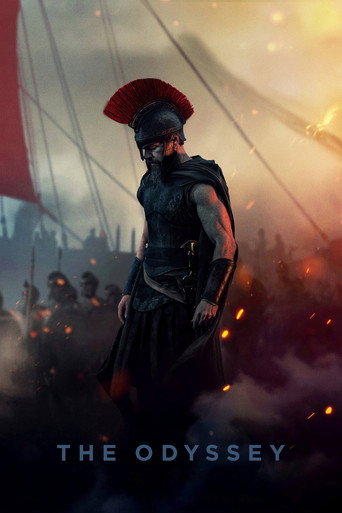
The Odyssey (2026)
Odysseus, the legendary King of Ithaca, embarks on a long and perilous journey home following the Trojan War. Throughout his voyage, he is forced to confront the whims of gods, mythological monsters, and trials that stretch both his cunning and his humanity to the breaking point.
Overview, poster, and credits from TMDB.
Read and watch our full recap ↓FROM THE RECAPRUSH LIBRARY · FULL RECAP
The Odyssey (2026) Recap & Ending Explained: Why Odysseus Leaves Ithaca Again
12 min read · Estimated reading time— views
Intro + RecapRush Viewpoint
Major spoilers follow. Christopher Nolan's The Odyssey follows Odysseus after the Trojan War, but its destination is not simply Ithaca. The 173-minute film turns the warrior's voyage into an argument about guilt, memory and whether a celebrated king can still deserve the home waiting for him. Universal released it in U.S. theaters on July 17, 2026.
RecapRush viewpoint — interpretation: Nolan's decisive change is to make homecoming an ethical test rather than a reward. Odysseus can defeat monsters and reclaim his household, yet the ending asks whether victory means anything if he resumes the same identity that war corrupted.
Featured Image
Table of Contents
Quick Facts
| Item | Verified information |
|---|---|
| Film | The Odyssey (2026) |
| Writer/director | Christopher Nolan |
| Producer | Emma Thomas |
| Studio/distributor | Universal Pictures |
| Source | Homer's Odyssey |
| Genre | Adventure; action; fantasy |
| U.S. theatrical release | July 17, 2026 |
| Runtime | 173 minutes — TMDB |
| Principal cast | Matt Damon, Tom Holland, Anne Hathaway, Robert Pattinson, Himesh Patel, Charlize Theron |
| Format | Shot entirely with IMAX film cameras |
| TMDB movie ID | 1368337 |
The official film site confirms Nolan, the July 17 U.S. date and the all-IMAX-film-camera production. TMDB uses July 15 as its general database date; that should not be mistaken for the official U.S. opening.
Full Spoiler Recap
This recap follows the film's verified major arc and conclusion. It compresses some of the nested storytelling rather than inventing transitions or claiming that every Homeric episode appears unchanged.
1. Ithaca waits while a legend replaces a man
Years after Odysseus leaves for Troy, his household is occupied by suitors who consume his wealth and pressure Penelope to choose a new husband. Antinous is their most dangerous leader. Telemachus has grown up hearing stories about a father he barely knows, while Penelope continues to resist the idea that Odysseus is gone for good.
The Bard's account turns war into performance, establishing a tension that lasts through the film: public songs preserve Odysseus as a brilliant hero, but they cannot show the moral injury beneath that image. Telemachus travels in search of reliable news. Menelaus and Helen offer memories of Troy, including the stratagem of the wooden horse, which expose both Odysseus's ingenuity and the destruction his ingenuity enabled.
2. The Trojan Horse becomes the voyage's first monster
Nolan gives the fall of Troy unusual weight. Sinon is not merely a device in a clever trick; he becomes a human measure of its cost. The Greek victory unleashes slaughter, and Odysseus carries responsibility for creating the plan that brought the army inside the city. Vanity Fair's comparison with Homer identifies that guilt as the film's central change.
Odysseus's journey is therefore not delayed only by wind, water and monsters. He cannot psychologically arrive while treating Troy as a clean triumph. His later trials repeatedly strip away the heroic story he tells about himself.
3. The sea destroys certainty and command
Odysseus leads his surviving men through the encounters that define the legend. The Cyclops Polyphemus traps the crew and eats members of it before the survivors blind him and escape. The film retains the brutal outline but omits Homer's famous “Nobody” wordplay. People's guide to the adaptation's omissions confirms that distinction.
Other dangers include Circe, the Sirens, Scylla and Charybdis. Nolan presents the divine world selectively and grounds much of the terror in physical experience. The Sirens' song reaches Odysseus as he is bound to the mast, but the film does not give the audience a clean, seductive musical revelation. The subjective, muffled treatment denies viewers the certainty Odysseus wants.
Eurylochus increasingly challenges a captain whose choices keep exposing the crew to danger. Men disappear, loyalty fractures and command becomes harder to distinguish from pride. The voyage finally leaves Odysseus without the company he promised to bring home.
4. Hades forces Odysseus to hear the dead
In the underworld, the past stops behaving like a victory song. Sinon confronts Odysseus as a casualty of the Trojan scheme, returning the story to the person used by a king's strategy. The scene makes the hero answer to somebody his legend would otherwise reduce to a footnote.
This is the turning point in Nolan's moral design. According to Pitchfork's review, Sinon functions as a counterweight to Odysseus's ethical framework. The dead cannot be restored by admitting guilt, but their presence prevents him from pretending that cleverness and righteousness are the same thing.
5. Calypso's island turns forgetting into captivity
Odysseus is stranded with Calypso, separated from Ithaca and from a reliable sense of time. The movie uses lotus-induced forgetting rather than reproducing every detail of Homer's relationship between the pair. Calypso's isolation gives the episode sadness as well as danger: remaining would suspend Odysseus between pleasure, amnesia and unfinished obligation.
He eventually leaves. His desire for Penelope and Telemachus survives, but “home” now carries two opposed meanings. It is the family he loves and the throne he may no longer believe he should hold.
6. Father and son prepare the return
Back on Ithaca, Odysseus conceals his identity and sees the suitors' abuse at close range. The loyal Eumaeus helps connect him with Telemachus. Father and son reunite, and the abstract figure Telemachus pursued becomes a damaged person who needs his help.
Penelope announces the bow contest: the man who can string Odysseus's bow and shoot through the aligned axe heads will win her hand. The test is also a trap. The disguised king succeeds where the suitors fail, reveals himself and turns the hall into a reckoning.
7. Odysseus wins the hall but refuses the old ending
Antinous falls first as Odysseus and his allies attack the suitors. The violence restores control of the household, but the film does not present it as proof that every wound has closed. Penelope and Odysseus finally confront what his absence and the war have made of them.
Nolan then departs sharply from Homer. Odysseus does not simply reclaim the throne and resume his reign. He accepts that the man who returned is not fit to continue ruling as though Troy and the voyage were detachable chapters. Telemachus becomes king. Odysseus and Penelope sail west together, choosing exile and a journey meant to honor the men who did not return.
Entertainment Weekly, the Los Angeles Times and JustWatch independently describe this final transfer of power and departure.
Cast + TMDB
Cast and Characters










Character names and person IDs were checked against TMDB movie 1368337's credits. The official film site's cast page and Rotten Tomatoes' credits provide independent production context.
Ending Explained
Why do Odysseus and Penelope leave after he finally gets home? The departure is voluntary and jointly chosen. Odysseus recognizes that reclaiming a building is not the same as recovering moral innocence. Penelope does not merely wait for him to restore the past; she goes with him into a future shaped by truth about what he did and lost.
RecapRush interpretation: Their westward voyage is neither a conventional victory lap nor a simple punishment. It is an act of accountability that remains active. Odysseus cannot repay the dead, but he can refuse to convert their deaths into a permanent title to power.
More from RecapRush
 Casablanca (1942) Recap & Ending Explained: Why Rick Lets Ilsa Go
 Spirited Away (2001) — Full Spoiler Recap & Ending Explained
 Attack on Titan Season 1 (2013) Recap & Ending Explained: Why the Final Monster Is Hidden Inside the Wall
Why does Telemachus become king? The transfer ends his life as the son of an absence. Throughout the film, Telemachus inherits stories about Odysseus before he inherits any real relationship with him. Taking the throne lets him build an identity that is informed by his father but not confined to imitation.
Our reading: Nolan replaces hereditary restoration with generational succession. Odysseus's most responsible political act is not defeating Antinous; it is recognizing that winning does not automatically make him the right person to govern.
Is the ending the same as Homer's? No. In the poem, Odysseus reestablishes himself as Ithaca's king, and Athena stops the cycle of revenge involving the suitors' families. The film omits that reconciliation and sends Odysseus and Penelope away. This is a deliberate thematic conclusion, not a missing post-credits setup.
RecapRush Interpretation
The following section is editorial interpretation. The film separates three versions of home: a place, a family and a moral condition. Odysseus can reach the island by ship and reach his family by revelation, but no journey can return him to the person who left before Troy. The final voyage becomes meaningful once he stops confusing restoration with reversal.
The Bard's songs matter because they offer a survivable version of war. A legend turns contradictory actions into a clean sequence of trials and victories. Nolan does not reject storytelling; he shows why people need it, then asks what it excludes. Sinon, Eurylochus and the lost crew restore the human cost that a hero-centered song pushes to its edges.
Penelope's choice also changes the meaning of waiting. She has not preserved Ithaca so that Odysseus can simply occupy his old role. By sailing with him after the household is secured, she becomes a participant in what comes next. The marriage survives because both people accept that reunion requires a new arrangement, not because time has frozen for them.
Telemachus completes the triangle. His early hunger for a father is also a hunger for a finished identity. Meeting Odysseus teaches him that inheritance is complicated: a parent can be loved, admired, judged and surpassed at once. His coronation is therefore not a consolation prize. It is the film's clearest statement that the future should not be governed forever by the myths of the past.
Deep Analysis & Key Themes
Cunning without accountability becomes exploitation
RecapRush analysis: Odysseus's intelligence saves lives, but the Trojan Horse also demonstrates how strategic brilliance can hide people inside its machinery. Sinon is useful to the plan, the soldiers are useful to victory and the dead become useful to the legend. The film's ethical question is not whether cunning is admirable; it is who pays when cleverness treats human beings as pieces.
That is why the film diminishes some of the “master trickster” material familiar from Homer. Vanity Fair notes that the Cyclops episode loses the famous name-game. The change directs attention away from a verbal triumph and toward consequence.
War follows the warrior home
The Washington Post's discussion identifies aging, trauma and the cost of heroism as central to this adaptation. Our analysis: the monsters work both as literal threats and as pressure on a damaged command structure. Odysseus's authority survived the war institutionally, but it does not survive the journey unquestioned.
Homecoming stories often promise that endurance will make suffering worthwhile. Nolan is more suspicious. Arrival can prove that a person endured without proving that every decision was justified. The film allows Odysseus to be brave and culpable at the same time.
The gods are present through uncertainty
Athena remains important, while much of the divine machinery is less explicit than in Homer. Natural force, coincidence, intuition and belief overlap. RecapRush analysis: that ambiguity keeps responsibility with the characters. A god may guide or obstruct, but divine explanation cannot absorb Odysseus's moral choices.
The Sirens sequence applies the same strategy to desire. By restricting the audience's access to what Odysseus hears, the film makes temptation private. Viewers see its power through behavior rather than receiving an objective answer about the perfect song.
Spectacle argues with the antiwar theme
The movie's enormous practical production gives ships, sea and combat a physical scale. The official site emphasizes that it was shot entirely with IMAX film cameras. Our analysis: this creates a productive tension. The film condemns the way violence becomes legend while also using spectacle to make that legend exhilarating.
The Society for Classical Studies offers a useful critical counterview, arguing that the adaptation enlarges suffering while reducing important dimensions of cunning and women. That critique matters: the film's moral seriousness does not automatically resolve what its compression leaves out.
A better ending requires relinquishing power
RecapRush analysis: An apology made from a throne can remain another form of control. Odysseus's departure gives his recognition material consequences. He gives up status, permits succession and chooses a journey with Penelope whose purpose is not conquest.
That decision does not erase the suitors' bloodshed or settle every political consequence. It instead refuses the neatest possible ending. Redemption remains a direction of travel, not a certificate granted by the last scene.
What Most Viewers Missed
These are details and structural choices worth reconsidering, not a claim that most audiences literally failed to notice them.
- The Bard frames the problem of adaptation. A song must compress events into a memorable shape, just as a feature film compresses Homer. The movie openly warns that every retelling chooses who remains visible.
- Sinon links victory to victimhood. His return in Hades prevents the Trojan Horse from functioning only as evidence of Odysseus's genius.
- Calypso's lotus changes the moral texture of delay. The island is not simply a romantic detour; forgetting becomes a threat to responsibility.
- The gods are selectively embodied. Athena's presence stands out because Nolan avoids turning the entire divine order into an explanatory cast of characters.
- The final voyage reverses the first one. Odysseus originally sails toward war and fame. He ends by sailing away from power, with Penelope beside him, to remember the people the fame concealed.
- Telemachus inherits a warning as well as a kingdom. His father's story offers experience to learn from, not a script to repeat.
Mid/Post-Credits
There is no mid-credits or post-credits scene. Decider's credits guide confirms that the narrative ends before the credits. The credit music includes “When I'm Home,” but it is not accompanied by an additional story scene or sequel reveal.
Final Thoughts
RecapRush verdict — interpretation: The Odyssey works best when its scale serves a painfully intimate question: what if the person who reaches home is no longer the person for whom home was preserved? Nolan answers without denying love or offering moral amnesia.
Odysseus earns reunion but does not assume that reunion entitles him to rule. Penelope chooses a future instead of being reduced to a reward, and Telemachus receives the chance to govern without waiting for a legend to end. The westward ship therefore completes the story without closing its ethical work. Home is real, but becoming worthy of it remains a voyage.
Join the conversation
What did you think of the ending? Share your interpretation. Spoilers may appear below.
This product uses the TMDB API but is not endorsed or certified by TMDB.
No comments yet. Start the conversation.