
RECAPRUSH MOVIE GUIDE
Weapons (2025)
Directed by Zach Cregger
When all but one child from the same class mysteriously vanish on the same night at exactly the same time, a community is left questioning who or what is behind their disappearance.
Overview, poster, and credits from TMDB.
Read and watch our full recap ↓FROM THE RECAPRUSH LIBRARY · FULL RECAP
Weapons (2025) Recap & Ending Explained: Why Alex Turns Gladys’s Spell Against Her
12 min read · Estimated reading time— views
Intro + RecapRush Viewpoint
At 2:17 a.m., seventeen children leave their homes and run into the darkness with the same unnatural posture. Weapons begins with an absence that turns an entire town into a machine for producing blame. The children’s teacher, Justine Gandy, becomes the easiest target; Archer Graff, whose son is missing, becomes the loudest accuser; and Alex Lilly, the only child from the class who remains, quietly carries a secret no adult can see.
RecapRush’s view is that Zach Cregger’s horror mystery is ultimately about children forced to manage dangers created by adults. Its chapter structure keeps changing our moral distance from the characters. A suspicious teacher becomes a frightened investigator, an angry father becomes a desperate ally, and a seemingly ordinary household becomes the center of the nightmare.
Spoiler warning: This article reveals the complete plot, the identity of the villain, the children’s fate and the ending. Interpretive sections are RecapRush analysis; verified production facts and plot events are cited in References.
Featured Image
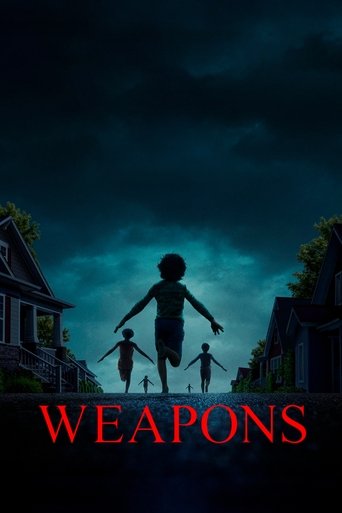
!Official poster for Weapons showing the 2025 horror mystery's red visual motif
Image source: TMDB’s verified Weapons record. Promotional poster; rights remain with the respective rights holders.
Table of Contents
Quick Facts
- Title: Weapons
- Year: 2025
- Type: Live-action feature film
- U.S. theatrical release: August 8, 2025
- Runtime: 129 minutes
- Director and writer: Zach Cregger
- TMDB movie ID: 1078605
- TMDB genres: Horror; Mystery
- Article type: Full spoiler recap and ending explanation
The story is presented in intersecting character chapters. Events overlap and acquire new meanings as the movie returns to the same night from another person’s point of view.
Full Spoiler Recap
1. Seventeen children disappear
A child narrator describes a frightening event in Maybrook: seventeen third-grade students from Justine Gandy’s class run out of their houses at exactly 2:17 in the morning and vanish. Doorbell cameras record their strange, coordinated flight. Only Alex Lilly appears at school afterward.
The community demands an explanation that the authorities cannot provide. Because every missing child shared Justine’s classroom, grieving parents focus their suspicion on her. Archer Graff, father of missing boy Matthew, is especially hostile. Justine is placed on leave and begins drinking again.
The opening turns correlation into social evidence. The parents’ anger is understandable, but it creates a premature story: one teacher must somehow be responsible because the children share her class. The film lets that accusation linger long enough to show how fear can harden into certainty.
2. Justine notices that Alex’s home is wrong
Justine remains worried about Alex. She follows him and sees that his house is covered to block outside attention. Inside, his parents sit in a near-catatonic state. During one of Justine’s attempts to watch the house, Alex’s entranced mother takes a lock of her hair.
Justine also reconnects with Paul Morgan, a married police officer with whom she has a troubled history. Their relationship complicates her credibility and reveals why she is vulnerable to the town’s judgment. The movie does not make her a flawless detective; it makes her someone whose imperfect choices coexist with a correct instinct that Alex is in danger.
3. Archer follows the children’s path
Archer refuses to wait for official answers. Comparing camera footage, he realizes that the children were not scattering randomly. Their routes converged toward the same destination. His investigation gradually redirects his rage away from Justine and toward the location the evidence indicates.
Recurring nightmares and unsettling images blur the border between intuition and supernatural influence. Archer and Justine reach similar suspicions from different directions. Their eventual cooperation becomes possible only after both release the roles the town assigned them: accuser and accused.
4. James discovers the children
James, a homeless man struggling with addiction, becomes entangled with Paul after a violent police encounter. Later, James enters Alex’s house looking for valuables and discovers the missing children standing motionless in the basement.
He tries to report the discovery and claim the reward. Paul, fearing exposure of his earlier misconduct, pursues him. James tells Paul where the children are, and the two go to the house. Paul enters, then returns under supernatural control and drags James inside.
This chapter makes the mystery’s answer briefly available through the least socially credible witness. James knows the truth, but his circumstances make it easy for others to dismiss or exploit him. The film uses that imbalance to show how facts can remain powerless when the person carrying them lacks institutional trust.
5. Marcus meets Aunt Gladys
School principal Marcus Miller agrees that Alex needs a welfare check. A strange woman named Gladys appears and identifies herself as Alex’s aunt. Her cheerful manner barely conceals menace. When Marcus continues to press the issue, Gladys steals what she needs for a ritual.
Using a personal link to Marcus’s husband, Terry, she places Marcus under her control. He kills Terry and is then directed toward Justine. At a gas station, Marcus attacks. Archer intervenes long enough for Justine to escape, and Marcus is struck and killed.
The attack finally proves that Justine’s fear is not paranoia. It also gives her and Archer the reason to compare what they know. They determine that the children’s routes led to Alex’s house.
6. Alex’s chapter reveals Gladys’s system
Gladys is a distant relative whom Alex’s mother allowed into the home. She quickly used ritual magic to dominate his parents. Their bodies remain alive, but their agency has been taken. Gladys hurts them whenever she needs to force Alex’s obedience.
Alex is therefore not the untouched child the town imagines. He has been performing normality at school while serving as the caregiver and captive inside his own house. Gladys orders him to collect personal items connected to his classmates. She uses those items to summon the children and confines them in the basement, draining their vitality.
Alex keeps the children alive by feeding them. His silence is not consent; it is the survival strategy of a child whose parents have become hostages. This revelation reorganizes the whole movie. The one student who did not disappear has been living at the center of the disappearance.
7. The adults enter the house
Archer and Justine arrive as Gladys prepares to leave. Paul and James, both bewitched, attack them. Justine kills the attackers in the struggle. Archer finds the basement but falls under Gladys’s control.
Alex realizes that the same method used to turn people into weapons can be redirected. He alters one of Gladys’s ritual objects so that the spell targets her. The seventeen children awaken and pursue Gladys through the neighborhood.
Their chase is grotesque and cathartic. The children catch Gladys and tear her apart. Her death ends the direct control, but freedom does not instantly restore everyone she damaged.
8. Rescue is not recovery
Archer carries Matthew home. Justine finds Alex with his parents, but the household cannot simply return to its former state. Alex’s parents are institutionalized, and he later moves away to live with another aunt.
The missing children return to their families. Some gradually begin speaking again, but the narration refuses a total recovery. The mystery has been solved; the trauma remains.
That final distinction is the movie’s most honest choice. Being found is an event. Healing is a process whose outcome cannot be guaranteed by the end of a horror plot.
Cast + TMDB
Cast and Characters










This article is matched to TMDB movie 1078605. The principal credited cast includes Julia Garner as Justine, Josh Brolin as Archer, Alden Ehrenreich as Paul, Austin Abrams as James, Benedict Wong as Marcus and Amy Madigan as Gladys.
More from RecapRush
 Whalefall (2026) Recap & Ending Explained: Jay’s Escape and His Father’s Letter
 Wildwood (2026) Recap & Ending Explained: Why Prue’s Rescue Has to Become a Rebellion
 The End of Oak Street (2026) Recap & Ending Explained: Why Greg Is Alive Again
The gallery below is powered by the saved TMDB record and links each available portrait to its RecapRush actor profile. A duplicate actor-character table is intentionally omitted.
Ending Explained
Why were the children taken?
Gladys needed energy to sustain herself. She forced Alex to gather personal objects from his classmates, then used those connections in a ritual that summoned the children to his house. They remained in the basement under her control while she drew vitality from them.
The film does not provide a definitive scientific rulebook for her magic. It gives viewers enough cause and effect to understand the kidnapping while preserving uncertainty about what Gladys actually is.
Why did Alex stay at school?
Alex was not one of Gladys’s summoned victims because she needed him functional. He maintained the appearance of normal life, collected what she demanded and cared for the people she had incapacitated. His ordinary school attendance protected her secret.
How does Alex defeat Gladys?
He uses her own ritual logic. By connecting the controlling object to Gladys, Alex redirects the children toward their captor. The title becomes literal: people deprived of agency have been made into weapons, first by Gladys and finally against her.
Do all the children recover?
They survive and return home, but the closing narration says recovery is uneven. Some later speak again. Alex’s parents remain severely affected and are institutionalized. The spell ending does not erase what prolonged control did to their minds and bodies.
What exactly is Gladys?
The movie deliberately leaves that unresolved. Cregger has discussed possible histories for her but has not confirmed one canonical origin. She can be understood as a witchlike human using dark magic, a more mysterious entity imitating family, or simply the embodiment of a corrupting force. Any single answer beyond what the film shows is interpretation.
RecapRush Interpretation
RecapRush reads Gladys as horror built from the collapse of a household’s normal roles. Alex should be receiving care; instead, he must provide it. His parents should protect him; instead, their captured bodies become instruments used to threaten him. A visitor welcomed as family converts hospitality into control.
The ending does not give Alex victory through greater physical strength. He wins because he understands the system better than the adults do. For weeks, he has observed its rules, maintained its victims and calculated what might keep everyone alive. The same knowledge imposed by captivity becomes the tool of resistance.
That does not romanticize what happened to him. Competence under abuse is not evidence that a child needed less protection. It is evidence of how much responsibility was wrongly placed on him.
Deep Analysis & Key Themes
Blame satisfies the town before truth can
Justine becomes a public answer before investigators find a factual one. She is imperfect enough to be believable as a suspect in the community’s imagination, yet none of those imperfections explains the disappearance.
The film distinguishes accountability from scapegoating. Asking why a responsible adult missed a warning sign can be legitimate. Deciding that discomfort constitutes proof is something else. Archer’s arc begins when evidence becomes more important than the story his grief first chose.
Every chapter changes who appears dangerous
The segmented structure is more than a puzzle device. James first appears threatening, then becomes a witness. Paul first carries institutional authority, then uses it to protect himself. Alex first looks like the unexplained exception, then becomes the person enduring the greatest invisible pressure.
This repeated change in viewpoint trains the audience to distrust easy moral sorting. Knowledge does not merely add detail; it changes responsibility.
The home is the hidden crime scene
Public attention concentrates on the school because all the children share a classroom. The true center is a house whose covered windows conceal coerced caregiving, immobilized adults and captive children.
The contrast matters. Institutions can count absences and hold meetings, but private suffering may remain unreadable when a child has learned to perform normality. Alex’s silence protects no abstract mystery. It protects his parents from immediate punishment while imprisoning him further.
The title describes stolen agency
Gladys turns Marcus, Paul, James, Archer and the children into instruments. Their bodies perform actions chosen by someone else. Calling them “weapons” directs attention away from what they do and toward who aims them.
Alex’s final reversal is morally complicated because liberation arrives through the same mechanism of control. Yet the target has changed from innocent people to the controller herself. The film stages resistance as the seizure of a system that offered its victims no clean alternative.
Survival does not produce a tidy ending
Many horror movies treat the villain’s death as emotional restoration. Weapons refuses that shortcut. The children are home, but some cannot speak. Alex has another guardian, but his parents are gone from his daily life. Archer recovers his son, but cannot recover the time or innocence taken from him.
This is why the closing narration is essential. It prevents the spectacle of Gladys’s death from being mistaken for a complete cure.
What Most Viewers Missed
Alex’s apparent normality is labor. He is not simply quiet or strange. He is maintaining Gladys’s cover, feeding captives and managing threats to his parents.
Justine and Archer solve the mystery only after they stop treating each other as the problem. Their alliance is not sentimental reconciliation; it is a practical correction to misdirected blame.
James reaches the answer before the authorities. His discovery emphasizes that evidence and credibility are not distributed equally.
Gladys’s destruction answers what she did, not what she is. The film closes the central plot while preserving the villain’s origin as genuine ambiguity.
The last line changes the genre of the ending. The children’s return looks like rescue. The narration reframes it as the beginning of an uncertain recovery.
Mid/Post-Credits
No verified mid-credits or post-credits narrative scene is included. The story ends with the child narrator explaining what happened to Alex, his parents and the returned children. This article does not invent a sequel tease.
Final Thoughts
Weapons earns its ending by refusing to let one explanation simplify every character. Gladys caused the disappearance, but the town’s behavior still matters. Justine was wrongly blamed, but her flaws do not disappear. Archer was cruel in grief, but his need to find Matthew was real. Alex saves the children, but he remains a child damaged by the burden of saving adults.
RecapRush’s final perspective is that the film’s true reversal occurs before the supernatural climax: the person everyone overlooks becomes the only one who understands how power works inside the house. Alex turns that knowledge outward, but freedom arrives with scars. That is why Gladys’s death feels satisfying without becoming comforting.
FAQ
Is Weapons a released movie or an upcoming preview?
It is a released 2025 feature film. This article therefore provides a full spoiler recap rather than a speculative preview.
Who is responsible for the children’s disappearance?
Gladys uses personal objects and ritual magic to summon and control them. Alex is coerced into helping her and secretly keeps the children alive.
Why does Gladys control Alex’s parents?
Their suffering gives her leverage over Alex and allows her to hide inside the family home. The director has connected this inverted child-caregiver dynamic to the fear of living with an impaired parent.
Does Archer’s son Matthew survive?
Yes. Archer carries Matthew home after Gladys is killed, although the closing narration makes clear that the children’s recovery is incomplete.
What is the correct TMDB ID?
1078605, stored as a movie ID.
Join the conversation
What did you think of the ending? Share your interpretation. Spoilers may appear below.
This product uses the TMDB API but is not endorsed or certified by TMDB.
No comments yet. Start the conversation.