
RECAPRUSH MOVIE GUIDE
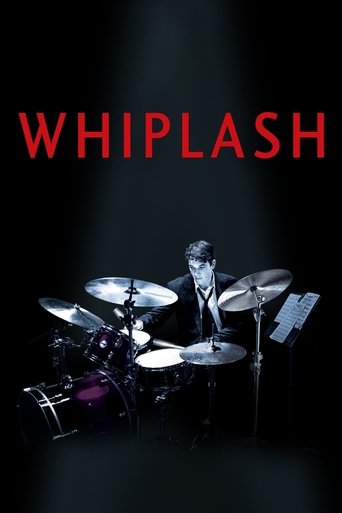
Whiplash (2014)
Directed by Damien Chazelle
Under the direction of a ruthless instructor, a talented young drummer begins to pursue perfection at any cost, even his humanity.
Overview, poster, and credits from TMDB.
Read and watch our full recap ↓FROM THE RECAPRUSH LIBRARY · FULL RECAP
Whiplash (2014) Recap & Ending Explained: Does Andrew Beat Fletcher or Become His Proof?
14 min read · Estimated reading time— views
Intro + RecapRush Viewpoint
Whiplash ends with a drummer taking control of a concert, but the person whose approval he wins is the person who tried to destroy him. That contradiction is not a loose end. It is the film's central trap: Andrew Neiman can resist Terence Fletcher's immediate command while still accepting Fletcher's definition of a worthwhile life.
RecapRush interpretation: The final solo is an artistic breakthrough without a clean moral victory. Andrew refuses to be publicly disposed of, yet his recovery brings him back into an intimate exchange with the abusive teacher he had escaped. The film lets the performance feel exhilarating without making exhilaration evidence that the abuse was necessary.
Spoilers and editorial note: This guide covers Damien Chazelle's complete 2014 feature, not the earlier short film. It uses AI-assisted research and drafting checked against the AFI synopsis, Sony's materials, published plot accounts and filmmaker interviews. It does not claim a first-hand screening. Plot facts, creator commentary and original interpretation are distinguished below. The story includes physical abuse, injury and discussion of a former student's suicide.

Table of Contents
Quick Facts
- Film: Whiplash (2014)
- Writer and director: Damien Chazelle
- Principal actors: Miles Teller, J.K. Simmons, Paul Reiser and Melissa Benoist
- Setting: The fictional Shaffer Conservatory in New York
- Runtime reference: 107 minutes in TMDB; AFI records 106–107 minutes
- TMDB genres: Drama, Music, Thriller
- TMDB movie ID: 244786
- U.S. theatrical opening: October 10, 2014; Sundance premiere earlier that year
- Music central to the plot: Hank Levy's “Whiplash” and “Caravan”
The Music classification does not mean characters break into musical-theater numbers. The performances are part of the story's competitive environment, while its pressure and reversals also explain the Thriller classification.
Full Spoiler Recap
Recognition gives Andrew an opportunity—and a new source of fear
Andrew is a nineteen-year-old drummer at Shaffer who wants exceptional status, not simply a place in a good band. Fletcher notices him and recruits him into the conservatory's elite ensemble as an alternate drummer.
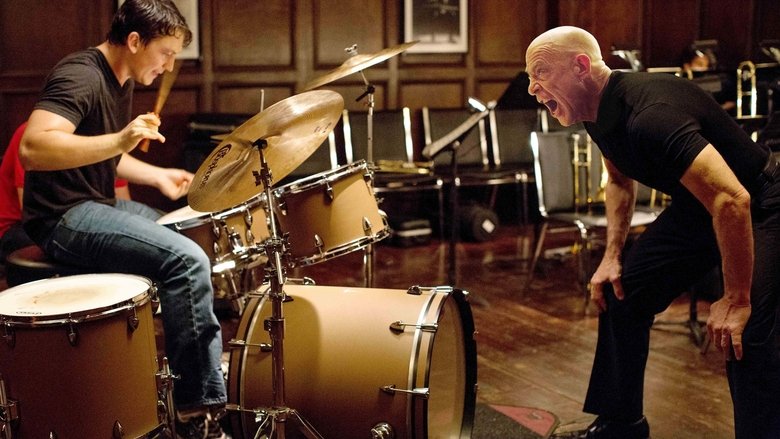
The apparent opportunity quickly becomes an ordeal. Fletcher insults students, throws a chair at Andrew and slaps him while demanding the right tempo. Andrew responds by intensifying his practice, even as his hands bleed.
RecapRush interpretation: Recognition and threat arrive through the same person. That makes rejection harder to dismiss: Andrew has invested Fletcher with the authority to identify greatness before discovering how cruelly he exercises it. A different teacher's praise might now seem less valuable precisely because it would be easier to obtain.
The missing music turns a supporting player into a rival
At a competition, Carl Tanner's sheet music disappears after Andrew sets it down. Carl cannot perform the piece without it; Andrew knows “Whiplash” from memory and takes over. The performance earns him the core position, but that position remains insecure when Fletcher brings Ryan into the contest for the drum chair.
Andrew's ambition also strains his life outside rehearsal. He argues with relatives over what counts as achievement and ends his relationship with Nicole, predicting that the demands of his future will make them resent each other.
The folder's disappearance creates an opportunity, but the released film does not conclusively identify a thief. Claims that Andrew or Fletcher definitely stole it go beyond what the story establishes.
Competition continues until Andrew can no longer function
Fletcher tells the band that former student Sean Casey has died in a car accident. He also subjects Andrew, Carl and Ryan to an exhausting contest for the lead role. Andrew eventually earns it back.
On the way to another competition, a transport problem sends Andrew rushing for a rental car. He then has to retrieve forgotten drumsticks. A collision leaves him injured, but he continues to the performance. He cannot play adequately in that condition. When Fletcher dismisses him, Andrew attacks him onstage and is subsequently expelled.
The crash is not Sean's crash; it happens to Andrew in the present narrative. Keeping those two references separate matters because the next revelation overturns Fletcher's account of Sean's death.
Sean's story exposes the damage behind Fletcher's legend
Andrew and his father Jim meet a lawyer representing Sean's family. Andrew learns that Sean died by suicide, not in a car accident, and that his family connects his distress to Fletcher's treatment. Andrew agrees to provide testimony about the abuse. Fletcher loses his job.
Andrew stops drumming for a time. Later he encounters Fletcher playing piano at a club. Their conversation suggests a possible reconciliation, but Fletcher still defends his approach to producing exceptional musicians. He invites Andrew to perform with his band at a jazz festival, offering familiar repertoire.
Andrew also reaches out to Nicole, only to learn that she has a new boyfriend. The time away has not preserved every relationship for his return.
The festival invitation is a setup
At the concert, Fletcher reveals that he knows Andrew supplied the testimony. He then starts “Upswingin’,” a piece Andrew has not been prepared to play and for which he lacks the music. The resulting failure is deliberate public humiliation, not an innocent last-minute alteration.
Andrew leaves the stage and his father embraces him. Instead of leaving the venue, Andrew returns to the kit and launches “Caravan,” forcing the performance away from Fletcher's intended course.
His extended solo changes their interaction. Fletcher goes from trying to contain Andrew to participating in the performance. The final exchange of looks and cue closes the film on musical recognition—not on an apology, an award ceremony or a later account of Andrew's career.
Cast and Characters
Cast and Characters





Use the linked TMDB cast gallery for actor profiles; the notes here focus on each character's place in the conflict rather than repeating a cast table.
Andrew Neiman: He wants his work to matter beyond the people immediately around him. His danger is the increasingly absolute rule he adopts for measuring that worth. He can be harmed by Fletcher and still make hurtful decisions of his own, especially toward Nicole.
Terence Fletcher: His authority comes partly from being able to recognize potential. He turns that ability into permission to injure people and reject accountability. The festival setup shows that his conduct is not simply rigorous teaching conducted in an unpleasant tone.
Jim Neiman: Andrew's father offers a relationship that does not have to be earned through a brilliant performance. That makes him a counterweight to Fletcher, not merely a man who fails to understand ambition.
Nicole: Andrew preemptively assigns her the role of obstacle. Her later relationship demonstrates that she has a life outside his plans. The film does not restore her as a reward for the protagonist's musical comeback.
Carl and Ryan: The competing drummers make scarcity tangible. One student's promotion is another's displacement, and none can assume approval will last.
Ending Explained
Why does Fletcher sabotage Andrew?
The immediate motive is retaliation for the testimony that cost him his conservatory position. The unknown opening piece creates a failure he can impose in front of an important audience.
Fletcher's philosophy gives him another way to interpret whatever follows. As Chazelle explained in his Filmmaker interview, Fletcher can regard either Andrew's disappearance or his extraordinary return as confirmation of his worldview. The teacher has constructed a system in which he need never admit that the test itself was wrong.
RecapRush interpretation: This is why the sabotage cannot be redeemed retrospectively as a generous secret lesson. Andrew's recovery is his response to an attack. The attack does not become benevolent because its target manages to produce something valuable afterward.
Does Andrew win the final confrontation?
He wins control of the musical moment. He returns voluntarily, initiates the familiar piece and refuses the ending Fletcher planned for him.
RecapRush interpretation: Control of a performance is narrower than freedom from a person's influence. Andrew no longer follows every command, yet Fletcher remains the crucial audience within the audience. The concert can therefore be a genuine act of resistance and a renewed attachment at the same time. Calling it only a defeat erases Andrew's initiative; calling it only liberation erases who still defines the prize.
More from RecapRush
 The Weight (2026) Recap & Ending Explained: Why Samuel Bargains With Clancy Instead of Killing Him
 Wildwood (2026) Recap & Ending Explained: Why Prue’s Rescue Has to Become a Rebellion
 KPop Demon Hunters (2025) Recap & Ending Explained: Why Rumi’s Truth Creates a Stronger Honmoon
What does Fletcher's final approval mean?
It confirms that he recognizes the extraordinary performance in front of him. It does not establish regret for his earlier actions or concern for Andrew's life beyond the kit.
RecapRush interpretation: Approval and care are not interchangeable. Fletcher may be delighted by what Andrew can now do without accepting responsibility for what he has done to Andrew. The ending's intimacy is consequently unsettling: the two men understand each other musically at the very point where that understanding might seal off other ways of living.
Why is Andrew's father shown watching?
Jim's presence preserves an outside perspective. He has just offered Andrew a way away from the immediate humiliation; now he watches him return to the stage.
Chazelle described the father-son separation in his Movie Mezzanine interview as a relationship progressively pulled apart. That creator commentary supports a darker reading, but the film does not supply Jim's spoken verdict after the concert.
RecapRush interpretation: His gaze interrupts the fantasy that a great performance settles every account. The same display can be a revelation to Fletcher and a frightening transformation to someone who values Andrew independently of achievement. Jim's importance is not that he can overrule the music, but that he keeps another measure of the person in view.
Do we learn what happens afterward?
No. The film does not show Andrew becoming famous, reconciling with Nicole, receiving treatment, dying young or building a lasting partnership with Fletcher. Predictions made by viewers—or possible futures discussed in interviews—are not additional scenes in the feature.
The ending is definite about this concert and open about the life that follows it.

Original Interpretation: Rebellion Inside the Same Value System
Andrew's return changes who starts the music, but not necessarily what success means. He rejects Fletcher's attempt to label him inadequate by delivering the kind of exceptional display Fletcher has demanded all along. The rebellion is powerful because Andrew acts; it is compromised because his action still seeks the validating response of the man who created the ordeal.
That distinction offers a more useful question than asking whether the film endorses hard work. Andrew has already worked relentlessly. The conflict is over which sacrifices can be called necessary, who gets to make that judgment, and whether the successful survivor is allowed to stand for everyone damaged by the system.
Sean's story prevents the concert from becoming a complete defense of Fletcher. One brilliant solo cannot restore another student's life. Nor can Andrew's ability demonstrate the counterfactual proposition that he would never have become excellent under different conditions. The film shows a chain of events, not a controlled experiment proving that cruelty produces greatness.
Our reading is therefore that the final smile resolves the men's immediate struggle while intensifying the film's ethical problem. Fletcher can fold the outcome into his legend. Andrew can experience recognition as transcendence. The audience can enjoy the music while declining the account of human expendability that accompanies it.
Deep Character and Theme Analysis
Andrew treats ordinary affection as an inferior kind of recognition
The breakup with Nicole is revealing because he forecasts a conflict before she has demanded the sacrifice he attributes to her. He manages uncertainty by removing a relationship from the equation.
RecapRush interpretation: This is not evidence that love and ambitious work are naturally incompatible. It shows how a person can make them incompatible by deciding in advance that only one deserves protection. Andrew wants freedom from possible resentment, but purchases it by denying Nicole any voice in the future he describes. Fletcher does not need to be present for that narrowing of life to occur.
Competition makes fellow musicians look like threats
The rotating drum chair makes approval temporary. Andrew's gain does not produce durable security because another player can immediately become the new standard.
RecapRush interpretation: Scarcity directs attention toward the judge instead of the ensemble. A band can contain many people while providing very little companionship. Chazelle's Seventh Row interview discusses this tension between a large group and a strong conducting hierarchy. Here, our reading is that Andrew's isolation is not merely the price of solitary practice; it also grows inside the room where collaboration ought to happen.
The film's excitement is part of its challenge
At BAFTA, editor Tom Cross explained that the finale needed the actors' changing relationship, not just instrumental spectacle. The looks between Andrew and Fletcher make the sequence a dramatic exchange rather than a detached demonstration of speed.
RecapRush interpretation: That construction gives the audience something Fletcher also wants: a moment so compelling that the surrounding damage becomes easy to push aside. The film does not have to remove pleasure in order to question it. Its harder demand is that viewers retain the earlier events while feeling the force of the ending.
Meaningful Details and Common Misreadings
The missing folder is not a solved crime. It creates a decisive change in Andrew's position, but an opportunity arising from a loss is not proof that its beneficiary engineered the loss. Treating a theory as fact would make Andrew's ambition simpler than the evidence permits.
The invitation does not mean Fletcher has reformed. His continued defense of his methods should make reconciliation uncertain before the concert exposes his revenge. A calmer setting is not the same thing as a changed ethic.
“Whiplash” is not the closing solo's piece. The last confrontation centers on “Caravan.” The distinction helps track the progress from learning the band's repertoire to taking the initiative over its performance.
Jim's embrace offers a real alternative. Andrew is not physically forced back to the kit. In our reading, the choice is more disturbing because the way out is available, affectionate and unglamorous.
No future trophy is required to finish this story. Cutting before a career outcome keeps the question on the relationship formed during the performance. A success montage would offer a retrospective verdict the film deliberately withholds.

Mid-Credits and Post-Credits Information
MediaStinger reports that the final song continues into the beginning of the credits and that there is no post-credits stinger. That is extra audio, not a later scene revealing Andrew's fate. This guide has not independently screened every theatrical or streaming edition.
Final Thoughts
RecapRush assessment: Whiplash is most unsettling when the solo works. Andrew produces a performance capable of overwhelming the room, and Fletcher receives an outcome he can claim as vindication. Neither fact cancels the cruelty that preceded it.
The ending's unresolved question is not whether Andrew can play. It is whether being recognized by Fletcher has become so important that every other form of recognition now feels insufficient. The music reaches a conclusion; the cost remains open.
FAQ
Is Whiplash a true story?
It is fiction informed by Chazelle's experience as a drummer. Shaffer and this plot should not be treated as a documentary record of a real student's relationship with a real instructor.
Why was Fletcher fired?
Complaints about his abusive conduct, supported by Andrew's testimony, lead to his dismissal. His later festival invitation is not proof that the complaint has been withdrawn.
Did Fletcher steal Carl's sheet music?
The released film does not conclusively identify who removed it. His responsibility is a theory, not an established reveal.
Does Andrew get back together with Nicole?
No reunion is shown. When Andrew contacts her before the festival, she has another boyfriend.
Is the final solo proof that Fletcher was right?
It proves Andrew can deliver that performance. It cannot prove abuse was the only way to develop his ability, and it does not erase the harm to other students.
Is there a scene after the credits?
The checked credits catalog reports no post-credits scene. The continuation of the music should not be confused with an additional narrative ending.
Join the conversation
What did you think of the ending? Share your interpretation. Spoilers may appear below.
This product uses the TMDB API but is not endorsed or certified by TMDB.
No comments yet. Start the conversation.